Quick answer: For 2026, preparing and filing annual accounts for a small UK limited company typically costs £500–£1,500 plus VAT when bundled with the Corporation Tax return, or from around £300 plus VAT for very low-turnover companies needing accounts only. Confirmation statement filing is a separate £50 Companies House fee, and late filing penalties start at £150.
If you’ve searched for small ltd company accounts cost, you’ve probably run into a confusing mix of numbers — some sites quote £300, others quote £2,500, and it’s rarely clear what’s actually included. Part of the confusion is that “accounts cost” gets used loosely to mean three different things: the statutory annual accounts filed with Companies House, the Corporation Tax return (CT600) filed with HMRC, and the £50 confirmation statement, which is a separate filing entirely. This guide separates those out and gives realistic 2026 pricing for each, plus what actually drives the final bill up or down.
What Counts as a “Small” Limited Company?
Companies House size categories matter because they determine what you’re legally required to file — and smaller categories generally mean cheaper, faster accounts preparation. Since 6 April 2025, a company qualifies as small if it meets at least two of these three conditions: turnover not exceeding £15 million, balance sheet total not exceeding £7.5 million, and no more than 50 employees on average. A company qualifies as a micro-entity — an even smaller category with lighter reporting requirements — if it meets at least two of: turnover not exceeding £1 million, balance sheet total not exceeding £500,000, and no more than 10 employees.
| Category | Turnover | Balance Sheet | Employees |
|---|---|---|---|
| Micro-entity | Up to £1m | Up to £500,000 | Up to 10 |
| Small company | Up to £15m | Up to £7.5m | Up to 50 |
Most single-director contractor and freelancer limited companies fall into the micro-entity band, which is why the cheapest quoted accounts prices on comparison sites tend to assume this category rather than the wider “small company” definition. It’s worth noting that these Companies House size categories are separate from, and shouldn’t be confused with, the VAT registration threshold of £90,000 turnover — a company can be well within micro-entity territory by Companies House’s definition while still being required to register for VAT, and vice versa. The two thresholds serve entirely different purposes and are checked against different figures at different times.
What’s Actually Included in “Accounts Cost”?
This is where most confusion comes from. A typical limited company compliance package bundles together three distinct filings, and it helps to know which is which before comparing quotes:
- Statutory annual accounts — filed with Companies House, prepared from your bookkeeping records, and (for anything above micro-entity size) including a profit and loss account, balance sheet, and notes.
- Corporation Tax return (CT600) — filed separately with HMRC, calculating and reporting Corporation Tax owed on company profits.
- Confirmation statement — a separate, simpler filing confirming your company’s registered details are up to date, costing a flat £50 to file online with Companies House (up from £34 before February 2026), regardless of who prepares it.
Most accountants quote a single bundled fee covering the first two together, since the underlying financial data overlaps almost entirely — but the confirmation statement fee is a hard Companies House cost that applies on top, no matter how cheap your accounts package is.
Typical Small Ltd Company Accounts Costs in 2026
| Company Profile | Typical Accounts + CT600 Cost |
|---|---|
| Micro-entity, turnover under £10,000 (dormant or near-dormant) | £150–£300 |
| Micro-entity, turnover under £50,000, clean records | £500–£800 |
| Small company, turnover £50,000–£150,000 | £800–£1,500 |
| Small company, turnover £150,000+, with VAT/payroll | £1,200–£2,500 |
| Full-service package (accounts, CT600, confirmation statement, director’s Self Assessment) | £1,200–£1,800/year, or £60–£350/month |
These figures are for accounts and Corporation Tax filing together, exclude VAT on the accountant’s own fee unless stated otherwise, and assume reasonably organised bookkeeping going in. Add the separate £50 Companies House confirmation statement fee to any of these regardless of package size.
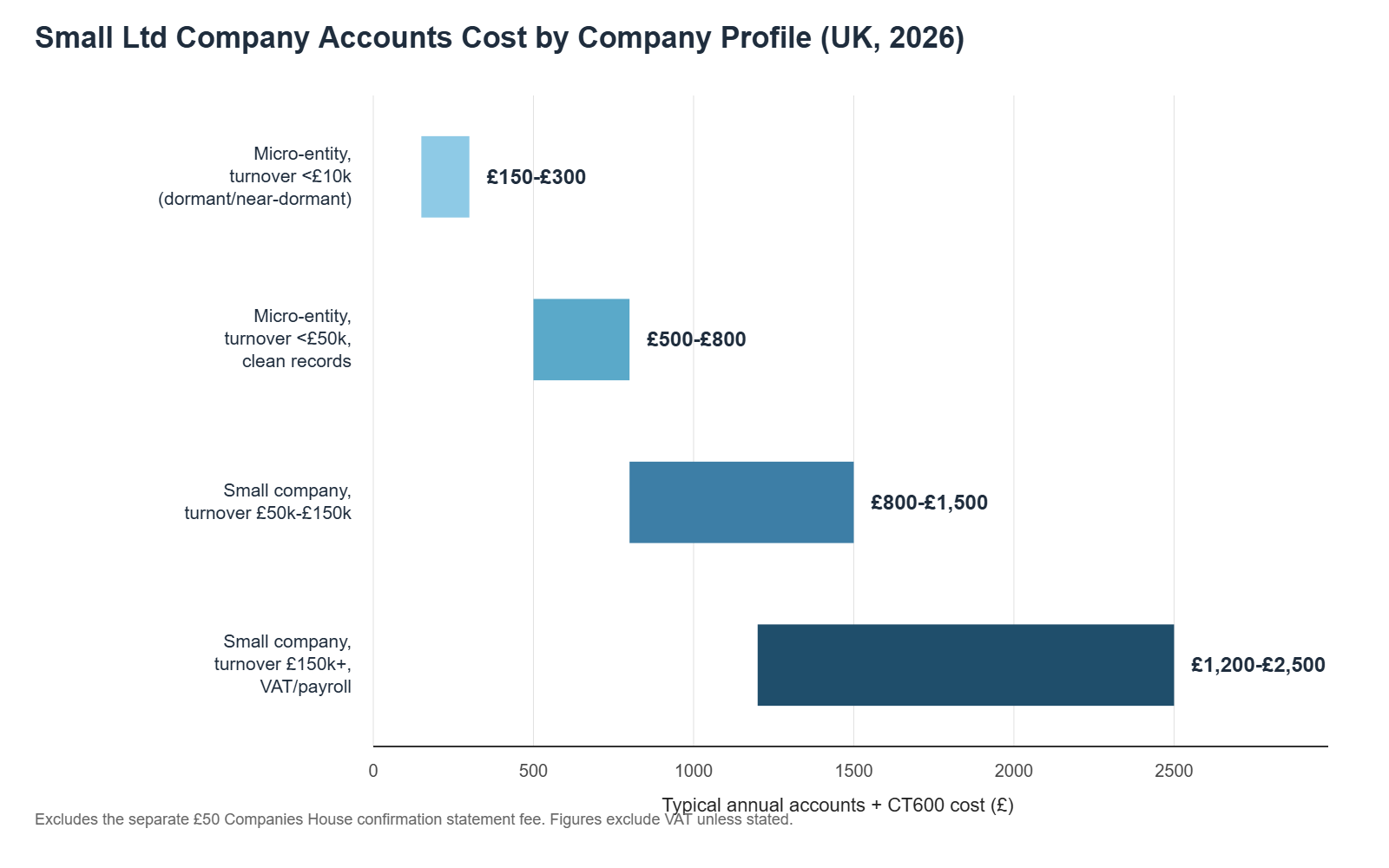
Typical small ltd company accounts cost by company profile, UK 2026.
Micro-Entity vs Small Company Accounts: Why the Cost Differs
Micro-entity accounts benefit from a simplified reporting format — a shorter balance sheet, minimal notes, and (until 1 April 2027, when this changes) no requirement to file a profit and loss account publicly. That simplicity translates directly into lower preparation time and therefore lower fees. Once a company grows past micro-entity thresholds into the wider small company category, accounts need fuller disclosure, and preparation time — and cost — rises accordingly, even before turnover or transaction volume are factored in separately.
DIY Filing vs. Hiring an Accountant
It’s technically possible to prepare and file small company accounts yourself directly with Companies House, and some very simple, low-activity companies do. However, Companies House’s free online filing service for full accounts (the CATO service) closed permanently in March 2026, which removed the main no-cost route smaller companies previously relied on for self-filing. Without it, DIY filers now need either commercial accounting software with a Companies House filing module or professional support — a meaningful shift that’s pushed some previously self-filing micro-entities toward paid help for the first time in 2026.
Even where DIY filing remains possible through commercial software, the real risk isn’t the filing mechanics — it’s getting the accounting treatment wrong. Incorrectly classified expenses, missed capital allowances, or an incorrectly prepared balance sheet can cause more expensive problems later than the fee saved by not using an accountant in the first place.
Companies House Fees You’ll Pay Regardless of Who Prepares Your Accounts
A few costs sit outside any accountant’s control, since they’re set by Companies House directly rather than by the person preparing your accounts:
- Confirmation statement: £50 online, £110 by post.
- Late filing penalties: £150 for accounts filed up to one month late, rising to £1,500 for accounts more than six months late. The penalty doubles if accounts are filed late in two consecutive financial years.
These penalties apply automatically to every private limited company, including dormant ones and micro-entities, regardless of the reason for the delay — which is one of the more common ways a “cheap” DIY filing ends up costing more than a professionally managed one, simply through a missed deadline.
What Else Affects the Final Bill
Beyond company size, a handful of specific factors move small ltd company accounts cost up from the baseline figures above. VAT registration adds quarterly return preparation on top of the annual accounts fee, typically £50–£150 per quarter. Running payroll, even for a single director-employee, adds ongoing monthly processing cost. Messy or incomplete bookkeeping — bank statements with no categorisation, missing receipts — routinely adds the most to a quote, since untangling a year of poorly kept records takes far longer than working from clean data. And a first-year filing, or any year involving a change of accountant, often costs slightly more than a routine annual repeat, since the incoming accountant needs to understand the company’s full history before filing anything. Multiple income streams within the company — for instance a trading business that also holds a rental property, or one that’s recently started selling through an online marketplace alongside its main trade — add a similar layer of complexity to accounts preparation as they do to personal tax returns, since each activity needs correctly separating and categorising within the same set of statutory accounts.
Corporation Tax on Small Company Profits
Since the accounts and CT600 are usually quoted together, it’s worth knowing what the Corporation Tax side of that bill is actually calculating. For the 2026 financial year, the small profits rate remains 19% on profits up to £50,000, the main rate is 25% on profits above £250,000, and profits falling between the two are taxed at a tapered effective rate through marginal relief. A micro-entity turning over £40,000 with modest profit will typically sit comfortably within the 19% band; it’s usually only once profits climb well past £50,000 that the accounts preparation and tax calculation both become noticeably more involved, since more allowances, reliefs, and potential marginal relief calculations come into play. None of this changes what the statutory accounts themselves cost to prepare, but it does explain why two companies with similar turnover can see different total compliance bills once the Corporation Tax calculation is added in.
Choosing an Accountant for Your Small Ltd Company Accounts
Price alone is a poor way to choose who prepares your accounts, partly because — as the case study below shows — the same quoted price range can hide very different scopes of work. A few practical checks narrow the field usefully. Confirming the firm or individual is registered with a recognised body such as ICAEW, ACCA, or AAT provides some baseline assurance of professional standards and a complaints route if something goes wrong. Asking specifically whether a quote covers accounts only, accounts plus CT600, or the full package including the confirmation statement and director’s Self Assessment avoids the most common source of quote confusion described earlier in this guide.
It’s also worth asking how the accountant handles software: an accountant already working in whichever cloud bookkeeping platform you use (or plan to use) will typically onboard faster and price more accurately than one still expecting spreadsheets or paper records. Finally, for a first-time filing or a company that’s just crossed from micro-entity into the wider small company band, ask directly whether the quote already reflects that change — pricing based on last year’s simpler filing requirements is a common way an initial quote ends up too low once the accountant actually starts work.
Fixed Fee vs. Hourly Billing for Accounts Preparation
Most UK accountants now quote small company accounts work as a fixed annual fee agreed before work starts, rather than billing by the hour, and for routine annual compliance this is usually the better arrangement for a director — it caps the cost regardless of how long the work actually takes. Hourly billing still appears for genuinely unpredictable situations: untangling several years of unfiled accounts, responding to a Companies House or HMRC query of unknown scope, or reconstructing records from a previous accountant who left mid-year. Typical hourly rates for this kind of work run £50–£150 for a general practitioner, rising to £150–£300 for a senior chartered accountant handling something more technical. If you’re quoted hourly for what should be a routine annual filing, it’s reasonable to ask for a fixed-fee alternative, or at minimum a not-to-exceed cap, since open-ended hourly billing on predictable compliance work tends to favour the accountant more than the client.
Case Study: Two Micro-Entities, Two Different Bills
Consider two single-director limited companies, each with turnover around £40,000 a year. The first keeps clean monthly records in cloud accounting software, invoices consistently, and has no VAT registration or payroll. Its accountant quotes £650 for combined accounts and Corporation Tax preparation, on top of the separate £50 confirmation statement fee — a straightforward, predictable annual cost.
The second has the same turnover but has been invoicing through a personal bank account for part of the year, has several unreconciled transactions, and registered for VAT partway through without telling their accountant in advance. Untangling the mixed personal/business transactions and backdating the VAT registration paperwork takes considerably longer, and the quote comes in at £1,400 — more than double the first company’s fee, for the same underlying turnover. The difference isn’t the size of the business; it’s the condition of the records handed over.
A third company, also around £40,000 turnover, illustrates a different scenario entirely: a contractor operating through a personal service company, paid via a single client on a rolling contract. Because IR35 status needs assessing alongside the standard accounts and CT600 work, and because dividend planning between salary and profit extraction adds a layer of tax planning beyond a straightforward trading company, the quote comes in around £950 — higher than the clean first example despite similar turnover, but for genuinely different reasons than the second company’s messy records. This is worth flagging because “small ltd company accounts cost” searches often come from contractors specifically, and contractor-specific factors (IR35, dividend versus salary splits) sit outside the scope of plain accounts preparation even though they usually get quoted together.
Quick answer: For 2026, preparing and filing annual accounts for a small UK limited company typically costs £500–£1,500 plus VAT when bundled with the Corporation Tax return, or from around £300 plus VAT for very low-turnover companies needing accounts only. Confirmation statement filing is a separate £50 Companies House fee, and late filing penalties start at £150.
If you’ve searched for small ltd company accounts cost, you’ve probably run into a confusing mix of numbers — some sites quote £300, others quote £2,500, and it’s rarely clear what’s actually included. Part of the confusion is that “accounts cost” gets used loosely to mean three different things: the statutory annual accounts filed with Companies House, the Corporation Tax return (CT600) filed with HMRC, and the £50 confirmation statement, which is a separate filing entirely. This guide separates those out and gives realistic 2026 pricing for each, plus what actually drives the final bill up or down.
What Counts as a “Small” Limited Company?
Companies House size categories matter because they determine what you’re legally required to file — and smaller categories generally mean cheaper, faster accounts preparation. Since 6 April 2025, a company qualifies as small if it meets at least two of these three conditions: turnover not exceeding £15 million, balance sheet total not exceeding £7.5 million, and no more than 50 employees on average. A company qualifies as a micro-entity — an even smaller category with lighter reporting requirements — if it meets at least two of: turnover not exceeding £1 million, balance sheet total not exceeding £500,000, and no more than 10 employees.
| Category | Turnover | Balance Sheet | Employees |
|---|---|---|---|
| Micro-entity | Up to £1m | Up to £500,000 | Up to 10 |
| Small company | Up to £15m | Up to £7.5m | Up to 50 |
Most single-director contractor and freelancer limited companies fall into the micro-entity band, which is why the cheapest quoted accounts prices on comparison sites tend to assume this category rather than the wider “small company” definition. It’s worth noting that these Companies House size categories are separate from, and shouldn’t be confused with, the VAT registration threshold of £90,000 turnover — a company can be well within micro-entity territory by Companies House’s definition while still being required to register for VAT, and vice versa. The two thresholds serve entirely different purposes and are checked against different figures at different times.
What’s Actually Included in “Accounts Cost”?
This is where most confusion comes from. A typical limited company compliance package bundles together three distinct filings, and it helps to know which is which before comparing quotes:
- Statutory annual accounts — filed with Companies House, prepared from your bookkeeping records, and (for anything above micro-entity size) including a profit and loss account, balance sheet, and notes.
- Corporation Tax return (CT600) — filed separately with HMRC, calculating and reporting Corporation Tax owed on company profits.
- Confirmation statement — a separate, simpler filing confirming your company’s registered details are up to date, costing a flat £50 to file online with Companies House (up from £34 before February 2026), regardless of who prepares it.
Most accountants quote a single bundled fee covering the first two together, since the underlying financial data overlaps almost entirely — but the confirmation statement fee is a hard Companies House cost that applies on top, no matter how cheap your accounts package is.
Typical Small Ltd Company Accounts Costs in 2026
| Company Profile | Typical Accounts + CT600 Cost |
|---|---|
| Micro-entity, turnover under £10,000 (dormant or near-dormant) | £150–£300 |
| Micro-entity, turnover under £50,000, clean records | £500–£800 |
| Small company, turnover £50,000–£150,000 | £800–£1,500 |
| Small company, turnover £150,000+, with VAT/payroll | £1,200–£2,500 |
| Full-service package (accounts, CT600, confirmation statement, director’s Self Assessment) | £1,200–£1,800/year, or £60–£350/month |
These figures are for accounts and Corporation Tax filing together, exclude VAT on the accountant’s own fee unless stated otherwise, and assume reasonably organised bookkeeping going in. Add the separate £50 Companies House confirmation statement fee to any of these regardless of package size.
Typical small ltd company accounts cost by company profile, UK 2026.
Micro-Entity vs Small Company Accounts: Why the Cost Differs
Micro-entity accounts benefit from a simplified reporting format — a shorter balance sheet, minimal notes, and (until 1 April 2027, when this changes) no requirement to file a profit and loss account publicly. That simplicity translates directly into lower preparation time and therefore lower fees. Once a company grows past micro-entity thresholds into the wider small company category, accounts need fuller disclosure, and preparation time — and cost — rises accordingly, even before turnover or transaction volume are factored in separately.
DIY Filing vs. Hiring an Accountant
It’s technically possible to prepare and file small company accounts yourself directly with Companies House, and some very simple, low-activity companies do. However, Companies House’s free online filing service for full accounts (the CATO service) closed permanently in March 2026, which removed the main no-cost route smaller companies previously relied on for self-filing. Without it, DIY filers now need either commercial accounting software with a Companies House filing module or professional support — a meaningful shift that’s pushed some previously self-filing micro-entities toward paid help for the first time in 2026.
Even where DIY filing remains possible through commercial software, the real risk isn’t the filing mechanics — it’s getting the accounting treatment wrong. Incorrectly classified expenses, missed capital allowances, or an incorrectly prepared balance sheet can cause more expensive problems later than the fee saved by not using an accountant in the first place.
Companies House Fees You’ll Pay Regardless of Who Prepares Your Accounts
A few costs sit outside any accountant’s control, since they’re set by Companies House directly rather than by the person preparing your accounts:
- Confirmation statement: £50 online, £110 by post.
- Late filing penalties: £150 for accounts filed up to one month late, rising to £1,500 for accounts more than six months late. The penalty doubles if accounts are filed late in two consecutive financial years.
These penalties apply automatically to every private limited company, including dormant ones and micro-entities, regardless of the reason for the delay — which is one of the more common ways a “cheap” DIY filing ends up costing more than a professionally managed one, simply through a missed deadline.
What Else Affects the Final Bill
Beyond company size, a handful of specific factors move small ltd company accounts cost up from the baseline figures above. VAT registration adds quarterly return preparation on top of the annual accounts fee, typically £50–£150 per quarter. Running payroll, even for a single director-employee, adds ongoing monthly processing cost. Messy or incomplete bookkeeping — bank statements with no categorisation, missing receipts — routinely adds the most to a quote, since untangling a year of poorly kept records takes far longer than working from clean data. And a first-year filing, or any year involving a change of accountant, often costs slightly more than a routine annual repeat, since the incoming accountant needs to understand the company’s full history before filing anything. Multiple income streams within the company — for instance a trading business that also holds a rental property, or one that’s recently started selling through an online marketplace alongside its main trade — add a similar layer of complexity to accounts preparation as they do to personal tax returns, since each activity needs correctly separating and categorising within the same set of statutory accounts.
Corporation Tax on Small Company Profits
Since the accounts and CT600 are usually quoted together, it’s worth knowing what the Corporation Tax side of that bill is actually calculating. For the 2026 financial year, the small profits rate remains 19% on profits up to £50,000, the main rate is 25% on profits above £250,000, and profits falling between the two are taxed at a tapered effective rate through marginal relief. A micro-entity turning over £40,000 with modest profit will typically sit comfortably within the 19% band; it’s usually only once profits climb well past £50,000 that the accounts preparation and tax calculation both become noticeably more involved, since more allowances, reliefs, and potential marginal relief calculations come into play. None of this changes what the statutory accounts themselves cost to prepare, but it does explain why two companies with similar turnover can see different total compliance bills once the Corporation Tax calculation is added in.
Choosing an Accountant for Your Small Ltd Company Accounts
Price alone is a poor way to choose who prepares your accounts, partly because — as the case study below shows — the same quoted price range can hide very different scopes of work. A few practical checks narrow the field usefully. Confirming the firm or individual is registered with a recognised body such as ICAEW, ACCA, or AAT provides some baseline assurance of professional standards and a complaints route if something goes wrong. Asking specifically whether a quote covers accounts only, accounts plus CT600, or the full package including the confirmation statement and director’s Self Assessment avoids the most common source of quote confusion described earlier in this guide.
It’s also worth asking how the accountant handles software: an accountant already working in whichever cloud bookkeeping platform you use (or plan to use) will typically onboard faster and price more accurately than one still expecting spreadsheets or paper records. Finally, for a first-time filing or a company that’s just crossed from micro-entity into the wider small company band, ask directly whether the quote already reflects that change — pricing based on last year’s simpler filing requirements is a common way an initial quote ends up too low once the accountant actually starts work.
Fixed Fee vs. Hourly Billing for Accounts Preparation
Most UK accountants now quote small company accounts work as a fixed annual fee agreed before work starts, rather than billing by the hour, and for routine annual compliance this is usually the better arrangement for a director — it caps the cost regardless of how long the work actually takes. Hourly billing still appears for genuinely unpredictable situations: untangling several years of unfiled accounts, responding to a Companies House or HMRC query of unknown scope, or reconstructing records from a previous accountant who left mid-year. Typical hourly rates for this kind of work run £50–£150 for a general practitioner, rising to £150–£300 for a senior chartered accountant handling something more technical. If you’re quoted hourly for what should be a routine annual filing, it’s reasonable to ask for a fixed-fee alternative, or at minimum a not-to-exceed cap, since open-ended hourly billing on predictable compliance work tends to favour the accountant more than the client.
Case Study: Two Micro-Entities, Two Different Bills
Consider two single-director limited companies, each with turnover around £40,000 a year. The first keeps clean monthly records in cloud accounting software, invoices consistently, and has no VAT registration or payroll. Its accountant quotes £650 for combined accounts and Corporation Tax preparation, on top of the separate £50 confirmation statement fee — a straightforward, predictable annual cost.
The second has the same turnover but has been invoicing through a personal bank account for part of the year, has several unreconciled transactions, and registered for VAT partway through without telling their accountant in advance. Untangling the mixed personal/business transactions and backdating the VAT registration paperwork takes considerably longer, and the quote comes in at £1,400 — more than double the first company’s fee, for the same underlying turnover. The difference isn’t the size of the business; it’s the condition of the records handed over.
A third company, also around £40,000 turnover, illustrates a different scenario entirely: a contractor operating through a personal service company, paid via a single client on a rolling contract. Because IR35 status needs assessing alongside the standard accounts and CT600 work, and because dividend planning between salary and profit extraction adds a layer of tax planning beyond a straightforward trading company, the quote comes in around £950 — higher than the clean first example despite similar turnover, but for genuinely different reasons than the second company’s messy records. This is worth flagging because “small ltd company accounts cost” searches often come from contractors specifically, and contractor-specific factors (IR35, dividend versus salary splits) sit outside the scope of plain accounts preparation even though they usually get quoted together.
How to Keep Small Ltd Company Accounts Costs Reasonable
A few habits reliably keep accounts costs toward the lower end of the ranges above. Using cloud bookkeeping software from day one, rather than reconstructing records at year-end, is the single biggest lever — most accountants price clean digital records noticeably lower than a shoebox of receipts. Registering for VAT proactively rather than after the fact avoids the backdated-paperwork premium seen in the case study above. Filing on time every year avoids both Companies House penalties and the “catch-up” premium some accountants charge for chasing overdue prior-year filings. And getting a written, itemised quote — one that states clearly whether it covers accounts only, accounts plus CT600, or the full package including confirmation statement and Self Assessment — prevents the most common source of billing surprises.
Common Mistakes When Budgeting for Accounts Costs
Assuming the £50 confirmation statement fee is included in every accountant’s quote is one of the most frequent misunderstandings, when in practice it’s a separate Companies House charge that applies regardless of who files it. Comparing quotes purely on headline price without checking whether VAT, payroll, or Self Assessment are included is another — a quote that looks £400 cheaper on paper sometimes excludes services that get billed separately later. Treating “dormant company” accounts as free is a third: even a company with no trading activity still needs dormant accounts filed, and while the fee is typically at the lowest end of the range, it isn’t zero.
Frequently Asked Questions
Do all small limited companies pay the same accounts cost?
No — cost scales with turnover, transaction volume, and record quality far more than with company size alone. A £10,000-turnover micro-entity with clean records can cost less than half what a similarly sized company with messy bookkeeping pays.
Is the £50 confirmation statement included in accounts preparation fees?
Not usually. It’s a separate Companies House filing and fee, distinct from the statutory accounts and Corporation Tax return, and applies on top of whatever an accountant charges for preparation.
Can I file small company accounts myself for free?
Companies House’s free online accounts filing service (CATO) closed permanently in March 2026. Self-filing is still possible through commercial software, but there’s no longer a no-cost government route for full accounts.
What happens if I file my accounts late?
Companies House applies an automatic penalty starting at £150 for filings up to one month late, rising to £1,500 for filings over six months late — and the penalty doubles if you’re late in two consecutive years.
Does a dormant company need to pay for accounts?
Yes, though the cost is typically at the lowest end of the range, since dormant accounts involve minimal preparation work compared to a trading company’s full accounts.
Why did my quote go up compared to last year?
Usually one of: turnover growth pushing you into a higher pricing band, new VAT or payroll obligations, or a change in how clean your records were handed over — ask your accountant to itemise what specifically changed.
Is it cheaper to use one accountant for accounts, tax, and payroll rather than separate providers?
Generally, yes. Bundling reduces the time any one provider spends reconciling data that’s already been reviewed elsewhere, and most accountants price a combined package below what the same services would cost individually from different firms.
Do I need an accountant if my company made no profit this year?
Even a loss-making or dormant company still has statutory filing obligations with both Companies House and HMRC, so the requirement to file doesn’t disappear — though the preparation work, and therefore the fee, is usually lower for a genuinely inactive company.
How far in advance should I get a quote before my filing deadline?
Ideally several months before your accounts are due, rather than in the final weeks — accountants managing multiple year-end deadlines at once often charge a premium for last-minute, time-pressured work, similar to the pattern seen with January Self Assessment deadlines.
Getting a Clear Quote
If you’d like a fixed-fee quote for your own small limited company’s accounts, confirmation statement, and Corporation Tax return, get in touch with the Tax Return Accountants team at info@taxreturnaccountants.uk with your turnover and current bookkeeping setup, and we’ll give you a like-for-like comparison against the ranges above.
Reviewed by the Tax Return Accountants team. Last reviewed: August 2026. Figures for Companies House thresholds, fees, and penalties are checked against current GOV.UK and Companies House guidance; accountant fee ranges reflect market research current as of publication and should be confirmed directly for your specific circumstances.
Sources
- Small Company Thresholds UK: What You Need to Know
- Preparing and filing Companies House accounts – GOV.UK
- Micro-entity accounts: all you need to know
- Companies House Late Filing Penalties 2026
- Companies House confirmation statement filing cost 2026/27
- How Much Does a Limited Company Accountant Cost in the UK in 2026?
- Year End Accounts Cost UK 2026: Accountant Fees Explained