
Written by Samina · Published: November 2026 · Last reviewed: November 2026 · Applies to the 2026/27 tax year
MerinTaxReturn is an information website. It does not prepare or file tax returns and does not give personal tax advice.
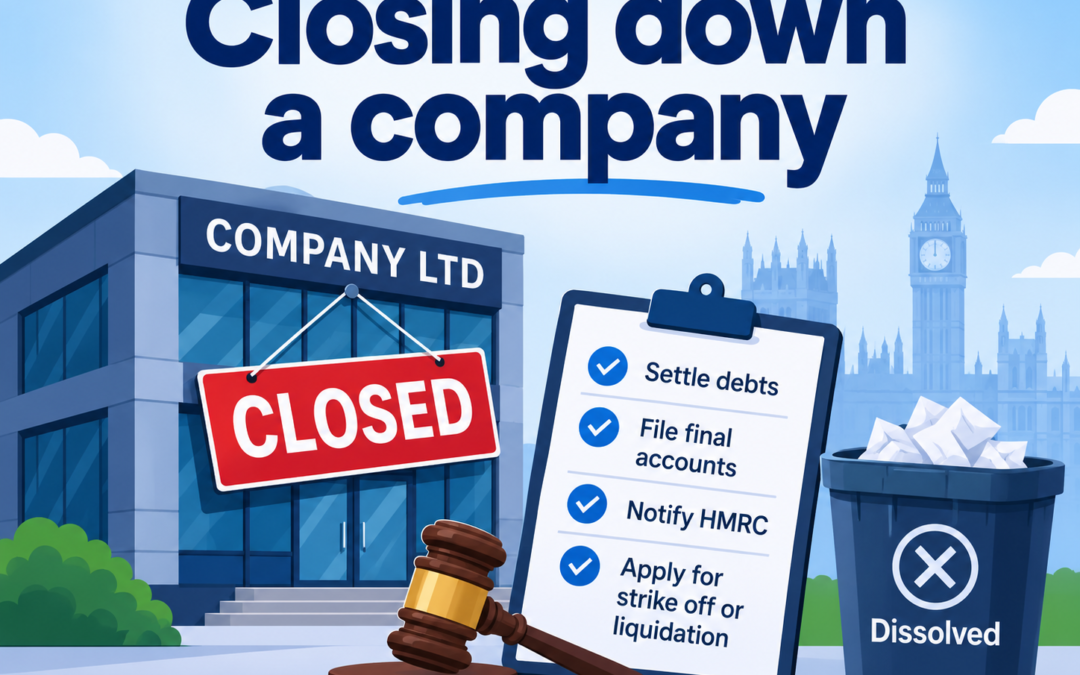
Closing down a company in the UK usually follows one of two paths. A solvent company that has stopped trading can apply for voluntary strike off on form DS01, costing £13 online or £18 on paper. Otherwise, a licensed insolvency practitioner liquidates it. Before either, pay the company’s debts, file final accounts and tax returns, and close payroll and VAT.
The business has done its job. A contract may have finished, you may be retiring, or the numbers no longer add up. What matters now is shutting the company down cleanly, so that nothing is left owing to HMRC, no cash is lost to the Crown and the final payout is taxed fairly.
This guide covers closing down a company for 2026/27: the available routes, current Companies House fees, the HMRC jobs to finish first, how money you take out is taxed, and practical questions about loans, staff and assets.
- Solvent companies normally close by voluntary strike off or a members’ voluntary liquidation (MVL).
- From 1 February 2026, form DS01 costs £13 online and £18 on paper.
- No trading, name change or other prohibited activity is allowed in the three months before applying.
- Total pre-strike-off distributions of up to £25,000 can be capital; go over and the whole amount is income.
- Cash and assets still in the company on dissolution pass to the Crown.
- Business Asset Disposal Relief, if you qualify, taxes gains at 18% from 6 April 2026, up to a £1 million lifetime limit.
What Does Closing Down a Company Mean?
A limited company is a legal person in its own right, so it carries on existing until it is taken off the Companies House register. GOV.UK summarises the routes on its page about closing a limited company. Three words cause most confusion:
- Dissolved (struck off): removed from the register. Every route for closing down a company ends here.
- Liquidated: a licensed insolvency practitioner takes over, deals with assets and creditors, then has the company dissolved.
- Dormant: still registered but doing no business. Accounts and confirmation statements continue, so the company is paused, not closed.
Solvent or insolvent?
A company is solvent if it can pay everything it owes. Solvent companies can choose strike off or an MVL. An insolvent company should not use strike off; its directors need advice from a licensed insolvency practitioner and must put creditors’ interests first.
Closing Down a Company: Your Options at a Glance
| Route | Suits | Typical cost | Usual timescale |
|---|---|---|---|
| Voluntary strike off (DS01) | Solvent companies with little cash left | £13 online or £18 paper, plus final accounts | Around 5 to 6 months from stopping |
| Members’ voluntary liquidation | Solvent companies with larger reserves | Practitioner fees, often from about £3,000 | Several months to a year |
| Creditors’ voluntary liquidation | Companies that cannot pay their debts | Practitioner fees | Several months or more |
| Dormant company | Owners who may restart | Yearly filings continue | Ongoing |
Liquidation costs are typical ranges quoted by insolvency firms, not official fees. A dormant company still needs the yearly filings described in our guide to accounts and tax returns for private limited companies.
Closing Down a Company by Voluntary Strike Off
For many owners, closing down a company means strike off: the lowest-cost route for a solvent company that has wrapped up its business. The directors apply to Companies House and the registrar removes the company after a public notice period.
Who can apply
Under Companies House guidance on striking off or dissolving a limited company, the company must not, in the previous three months, have traded, changed its name, sold trading stock or property for gain, or done anything beyond winding up its affairs and meeting legal duties. It also cannot be in, or facing, insolvency proceedings.
The steps
- Finish the business: stop trading, collect what customers owe, pay suppliers and staff, and complete the HMRC checklist below.
- Pay out what is left: distribute remaining cash to shareholders before applying, as anything left behind will be lost.
- Submit DS01: signed by a majority of directors. The filing fee is £13 online or £18 on paper.
- Notify within 7 days: send a copy to shareholders, creditors, employees, pension trustees and any director who did not sign.
- First Gazette notice: Companies House announces the proposed strike off.
- Dissolution: with no objection, the company is struck off at least two months after that notice, and a second notice confirms it.
Objections and withdrawing
Creditors, HMRC or anyone else with an interest can object, normally at least two weeks before the strike-off date. If the company trades again or stops meeting the conditions, the directors must withdraw the application at once; failing to do so can be an offence.
Members’ Voluntary Liquidation (MVL)
An MVL is a formal winding up of a solvent company, handled by a licensed insolvency practitioner. It costs more than strike off, but it is often chosen when closing down a company with substantial reserves.
- Declaration of solvency: the directors make a statutory declaration that the company will pay its debts in full, with interest, within a stated period of no more than 12 months. Making it without reasonable grounds is a criminal offence.
- Shareholders’ resolution: members pass a special resolution to wind up and appoint a licensed insolvency practitioner as liquidator. The declaration must be made in the five weeks before this resolution.
- Liquidator’s role: the liquidator collects and sells assets, deals with outstanding tax matters, submits the necessary returns and settles the company’s tax liabilities before distributing what remains.
- Final distributions: shareholders receive the surplus, in cash or as assets.
- Dissolution: once the liquidator files the final account, the company is usually dissolved about three months later.
The 12-month period in the declaration is a test of solvency, not a deadline for the liquidation itself, which can take longer. Payments by a liquidator are normally capital, whatever the amount, subject to the anti-avoidance rule covered below.
When the Company Can’t Pay Its Debts: CVL
An insolvent company cannot simply be struck off, and its creditors would be entitled to object. A creditors’ voluntary liquidation is started by the directors but run by an insolvency practitioner for creditors. The Insolvency Service explains directors’ duties, and early advice can reduce personal liability risks such as wrongful trading.
Your HMRC Checklist Before Closing Down a Company
Unfinished HMRC business is the most common reason a closure stalls, because HMRC can object to a strike off while returns or tax are outstanding.
- Final accounts and CT600: send final statutory accounts and a Company Tax Return to HMRC, marked as final, and pay the Corporation Tax. Companies House does not need these accounts for a strike off.
- Terminal loss relief: a trading loss made in the final 12 months of trading can be carried back against profits of the same trade in the three previous years, latest year first, under section 39 CTA 2010. Claim it on the final return.
- Payroll: pay final wages, send the last Full Payment Submission marked as final, issue P45s and tell HMRC the company has stopped employing people.
- VAT: see the next box.
- CIS: tell HMRC if the company was registered as a contractor or subcontractor.
- Directors’ own returns: report final salary, dividends or capital distributions on each director’s Self Assessment.
- Ask HMRC to cancel your VAT registration within 30 days of becoming ineligible, or a penalty may apply.
- HMRC usually confirms within 40 working days and sets an effective date, normally when trading stopped or the date you asked.
- Submit a final VAT return covering the period up to that date. VAT on invoices received later can still be reclaimed.
- Account for VAT on stock and assets you keep if you could reclaim VAT when they were bought and the total due is over £1,000.
- Keep VAT records for 6 years after cancelling.
Tax on the Money You Take Out
How the final cash is taxed depends on the route and the amount, and it often decides how you go about closing down a company.
The £25,000 rule before strike off
HMRC’s manual at CTM36220 allows distributions made in anticipation of strike off to be treated as capital, but only if:
- the total of all such distributions is £25,000 or less, with several payments added together,
- the company has paid, or intends to pay, its debts, and
- the company is dissolved within two years of the distribution.
GOV.UK states that if the amount is over £25,000, the whole sum is taxed as income, not just the excess. If dissolution doesn’t happen within two years, normal dividend treatment applies.
Business Asset Disposal Relief
Capital distributions fall under Capital Gains Tax. Under the Business Asset Disposal Relief rules, qualifying gains on disposals from 6 April 2026 are taxed at 18%. For company shares, throughout the two years before the disposal you must normally:
- hold at least 5% of the ordinary share capital and at least 5% of the voting rights,
- be entitled to at least 5% of distributable profits and assets on a winding up, or to 5% of the proceeds if the company were sold, and
- be an officer or employee of the company or a group company.
The disposal must generally happen within three years of the company ceasing to trade, and relief is capped by a £1 million lifetime limit on qualifying gains.
The phoenix (TAAR) rule
A capital distribution in a winding up can be taxed as income under the targeted anti-avoidance rule in section 396B ITTOIA 2005, but only if all four conditions apply:
- you held at least 5% of the shares and votes just before the winding up,
- the company was a close company when wound up or in the two years before,
- within two years of the distribution, you or someone connected carry on or are involved in a same or similar trade or activity, and
- it is reasonable to assume that avoiding or reducing income tax is a main purpose of the winding up or related arrangements.
Assumptions: Leila is an England taxpayer with a £30,000 salary and no other income or gains. Her shares cost £100. She fully qualifies for Business Asset Disposal Relief and has unused lifetime limit. 2026/27 figures: £500 dividend allowance, £3,000 CGT annual exempt amount.
- £22,000 by strike off: within £25,000, so capital. (£21,900 − £3,000) × 18% = about £3,400.
- £70,000 by strike off: over £25,000, so all of it is a dividend: about £19,900 of tax.
- £70,000 through an MVL: capital. (£69,900 − £3,000) × 18% = about £12,040, before the liquidator’s fee.
Rates are explained in our guide to dividend tax in the UK.
Practical Questions When Closing Down a Company
These five issues catch out many owners when closing down a company.
What happens to a director’s loan?
If you owe the company money (an overdrawn director’s loan account), repay it before closure, or the liquidator will expect repayment. If the company writes the loan off instead, the amount is normally taxed on you as a dividend, and the company may have extra tax or National Insurance points to deal with. If the company owes you money, it can repay you tax-free before any distribution to shareholders.
What happens to company assets?
Vehicles, equipment, stock and property must be sold or distributed before dissolution. Assets handed to shareholders “in specie” are valued at market value and count towards the £25,000 limit for strike off. Anything still owned on dissolution, including refunds that arrive later, passes to the Crown.
Can you close a company with outstanding tax?
A company cannot properly be struck off while Corporation Tax, PAYE or VAT is unpaid, and HMRC will usually object. If the company cannot pay, it is insolvent and liquidation is the route. Directors are not normally personally liable for company tax, but exceptions exist, for example where tax has been deliberately evaded.
What happens to employees?
Staff must receive proper notice, final pay including holiday pay, a P45 and any statutory redundancy pay they qualify for after two years’ service. Proposing 20 or more redundancies at one establishment within 90 days triggers collective consultation and an HR1 notification. If an insolvent company cannot pay, employees may claim from the government’s Redundancy Payments Service.
Can you transfer company assets before dissolution?
Yes, but treat it as a sale or a distribution, not a gift. Selling to a director or connected person should be at market value, and any gain is taxable for the company. Transfers can also have VAT consequences. Moving assets out at an undervalue while creditors remain unpaid can be challenged later.
What Happens After Your Company Is Dissolved
- Assets go to the Crown: property, cash and later refunds become bona vacantia.
- Bank account: frozen, with the balance passing to the Crown.
- Records: GOV.UK advises keeping business documents for 7 years after strike off, plus employers’ liability insurance details if you had staff.
- Restoration: administrative restoration is only available if the registrar struck the company off, it was trading at the time, and you apply within six years. The £341 fee is not the whole cost: overdue filings, penalties and, where there were assets, a £64 bona vacantia waiver letter may be added. After a voluntary DS01 strike off, a court order is normally needed.
How Long Closing Down a Company Takes
| Stage | Voluntary strike off | MVL |
|---|---|---|
| Before applying | At least 3 months with no prohibited activity | Declaration of solvency in the 5 weeks before the resolution |
| Start | File DS01, notify within 7 days | Special resolution, liquidator appointed |
| Middle | First Gazette notice | Assets realised, tax settled, distributions paid |
| End | Struck off at least 2 months after the notice | Final account, dissolution about 3 months later |
| Typical total | About 5 to 6 months or more from stopping | Several months to a year or more |
Objections, late returns or Companies House processing times can make either route longer.
Common Mistakes
| Mistake | Result | Better approach |
|---|---|---|
| Applying within 3 months of trading | Application invalid | Wait the full period |
| Leaving cash in the account | Lost to the Crown | Distribute before applying |
| Paying out over £25,000 before strike off | Whole amount taxed as income | Compare with an MVL first |
| Unpaid tax or missing final returns | HMRC objects | Clear HMRC tasks first |
| Ignoring an overdrawn director’s loan | Unexpected personal tax | Repay before closure |
Closing Down a Company: FAQs
How much does closing down a company cost?
Strike off costs £13 online or £18 on paper, plus final accounts. Liquidation adds insolvency practitioner fees, often several thousand pounds.
How long does it take?
For strike off, allow at least three months without activity before applying and at least two months after the Gazette notice: typically five to six months or more.
Can I close a company that owes tax?
Not by strike off while the tax is unpaid. Pay it first, or if the company cannot pay, take insolvency advice.
What happens to my director’s loan?
An overdrawn loan should be repaid before closure. If it is written off instead, the amount is usually taxed on you as a dividend.
What happens to the bank account?
It is frozen on dissolution and the balance passes to the Crown, so empty it once the last payments clear.
Do I need an accountant?
It isn’t compulsory, but final accounts, the CT600 and the tax on distributions are easier to get right with professional help.
Will I pay tax on the money I take out?
Usually, either as income or, under the £25,000 rule or a liquidation, as a capital gain.
Can I start a new company afterwards?
Yes. Income tax treatment only applies under the phoenix rule if all four of its conditions, including a tax-avoidance purpose, are met.
Can a struck-off company be restored?
A company struck off by the registrar may qualify for administrative restoration within six years. After a voluntary strike off, a court order is normally needed.
Should I make the company dormant instead?
If you might restart, dormancy keeps the company, but yearly accounts and confirmation statements continue.
Final Verdict: Closing Down a Company the Right Way in 2026/27
For a solvent company with modest reserves, closing down a company by voluntary strike off is simple and costs £13 online. With reserves well above £25,000, an MVL is often worth comparing, because capital treatment and Business Asset Disposal Relief may outweigh the fees. On any route, finish the HMRC tasks, settle loans and staff, and empty the bank account first.
- Read the DS01 guidance on GOV.UK and check the three-month conditions.
- Confirm your company’s duties in our guide to private and limited companies, and VAT on final costs in how to claim VAT back.
- Estimate the cash that will be left and whether it is above £25,000.
For advice on your own situation, speak to a qualified accountant, tax adviser or licensed insolvency practitioner.
- Fees, conditions and tax rules come from GOV.UK, Companies House, HMRC manuals and legislation.gov.uk, linked where each point is made.
- Liquidation costs are typical market ranges, not official figures.
- The worked example is illustrative, with its assumptions stated.
- GOV.UK – Close a limited company
- GOV.UK – Strike off: close down your company
- Companies House – Striking off or dissolving a limited company
- Companies House – How to apply for strike off (DS01)
- GOV.UK – Restore your dissolved company
- GOV.UK – Apply for a bona vacantia waiver letter (WA1)
- GOV.UK – Cancel your VAT registration
- HMRC – CTM36220: distributions before dissolution
- GOV.UK – Business Asset Disposal Relief
- legislation.gov.uk – ITTOIA 2005 s396B (winding-up TAAR)
- legislation.gov.uk – CTA 2010 s39 (terminal losses)
- The Insolvency Service