Written by Tax Return Accountants Editorial Team · Reviewed by Shamayun Chowdhury, ACMA · Last reviewed November 2026
The right VAT tax invoice format decides whether your customer can reclaim the VAT they paid you. Miss one required detail, and HMRC can refuse their claim, which quickly becomes your problem when they ask for a corrected invoice.
This guide sets out exactly what a UK VAT invoice must show for 2026/27, when you can use a shorter version, and the special wording some sales need. Every rule below has been checked against HMRC’s VAT Guide (Notice 700) and the VAT Regulations. It is general information, so speak to an accountant about your own business.
Key takeaways
- Only VAT-registered businesses can issue a VAT invoice, and they must issue one for standard-rated or reduced-rated sales to other VAT-registered businesses.
- A full invoice needs around a dozen set details, including your VAT number, the tax point and the total VAT in sterling.
- Sales of £250 or less (including VAT) can use a simplified invoice.
- Reverse charge and margin scheme sales need specific wording on the invoice.
- Send the invoice within 30 days of the tax point and keep copies for at least 6 years.
In this guide
- VAT tax invoice format? The short answer
- The full VAT tax invoice format, field by field
- Who must issue a VAT invoice, and when
- Simplified and modified VAT tax invoice format options
- Special wording: reverse charge, margin schemes and currency
- Common VAT invoice mistakes that cost money
- Storing VAT invoices for Making Tax Digital
- VAT tax invoice format? FAQs
- Final verdict
VAT Tax Invoice Format? The Short Answer
A VAT invoice is a sales invoice with extra details that prove VAT was charged. Regulation 14 of the VAT Regulations 1995 lists the particulars. In plain terms, a full invoice must carry the items in the table below.
| Field | What to show | Why it matters |
|---|---|---|
| Invoice number | A unique number from a sequential series | Stops gaps and duplicates, so HMRC can trace every sale |
| Issue date | The date you send the invoice | Starts the payment and record trail |
| Tax point | The time of supply, if different from the issue date | Decides which VAT return the sale belongs to |
| Your details | Business name, address and VAT registration number | Lets the customer check you are registered |
| Customer details | Customer name and address | Shows who received the supply |
| Description | Enough detail to identify the goods or services | Vague wording can block the customer’s VAT claim |
| Per line | Quantity, unit price, VAT rate and amount before VAT | Shows how the VAT was worked out |
| Totals | Total before VAT and total VAT in sterling | The figure the customer reclaims |
| Discounts | The rate of any cash discount offered | Required where you offer one |
A VAT tax invoice format with every field above is valid for any sale value. The shorter formats covered later are optional shortcuts with conditions attached.

The Full VAT Tax Invoice Format, Field by Field
Once you know what the VAT tax invoice format requires, the next step is getting each field right. Most rejected invoices fail on detail, not on missing boxes.
Number, dates and tax point
Number invoices in one continuous series, such as INV-0426 then INV-0427. You can run separate series, for example one per branch, as long as each number is unique. Show the issue date, and add the tax point when it differs. The tax point is often tied to when goods are delivered or work is finished, so it can fall before the date you raise the invoice.
Your details and the customer’s
Show your full trading name, address and VAT registration number. GOV.UK’s invoice rules add that a limited company must use its full registered name, and a sole trader must show their own name plus any business name they trade under. For the customer, a name and address is enough.
Description, quantity and VAT rate
Describe each item clearly enough that someone outside the business can tell what was sold. “Consultancy” alone is weak; “Bookkeeping, October 2026, 8 hours” is strong. For each line, show the quantity, the unit price, the VAT rate (20%, 5% or 0%) and the amount before VAT.
Totals in pounds sterling
Finish with the total before VAT and the total VAT payable. Under Notice 700, zero-rated or exempt items should be shown clearly as carrying no VAT, with their own separate total. You may round the total VAT down to the nearest penny, but retailers should not use that concession.
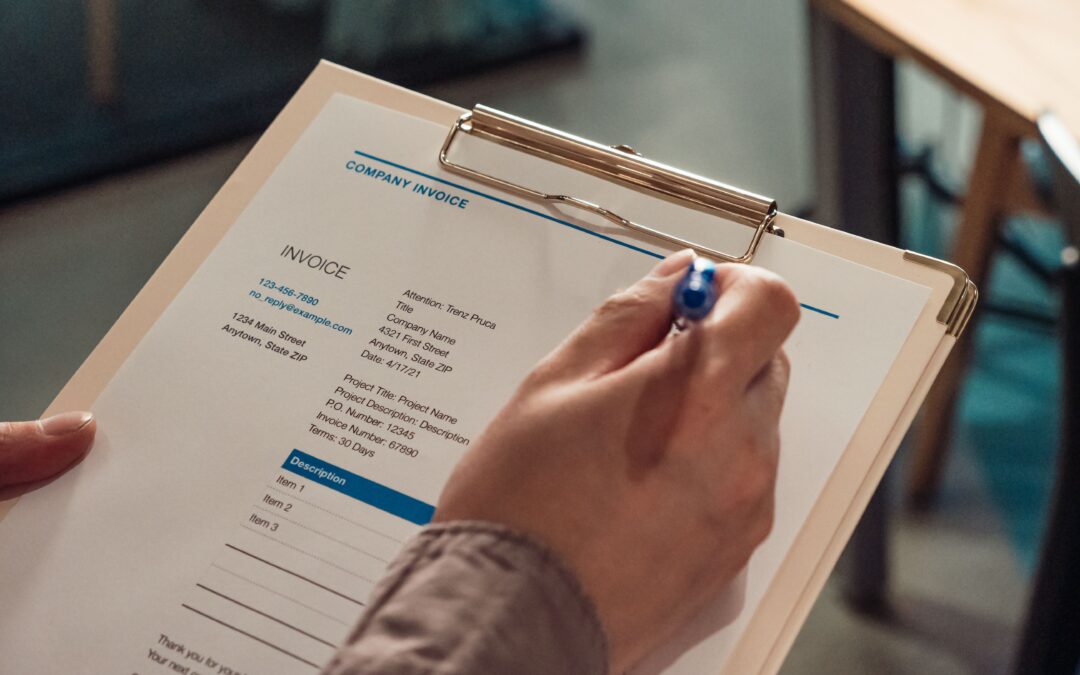
Here is how a VAT tax invoice format looks in practice for a simple business-to-business sale.
| Invoice part | Sample entry |
|---|---|
| Header | Bright Lane Joinery Ltd, 14 Example Road, Leicester LE1 0XX · VAT reg. no. GB 123 4567 89 (illustrative) |
| Invoice no. / dates | INV-0427 · Issue date 3 December 2026 · Tax point 28 November 2026 |
| Bill to | Harbour Café Ltd, 2 Sample Street, Nottingham NG1 0XX |
| Line 1 | Oak shelving, fitted (6 units × £150.00) · VAT 20% · Net £900.00 |
| Line 2 | Site visit and design (1 × £120.00) · VAT 20% · Net £120.00 |
| Totals | Net £1,020.00 · VAT £204.00 · Amount due £1,224.00 |
| Terms | Payment within 30 days · No cash discount offered |
The business, VAT number and addresses above are invented for illustration only.
Who Must Issue a VAT Invoice, and When
Only VAT-registered businesses can issue VAT invoices. You must register for VAT once your taxable turnover for the last 12 months goes over £90,000, and you can register voluntarily below that.
HMRC’s VAT Guide says you must issue a VAT invoice when you make a standard-rated or reduced-rated sale to another VAT-registered business. You don’t need one for zero-rated sales or for sales to consumers, though many firms provide one on request. The usual deadline is 30 days from the tax point.
Accountant’s tip: Set your accounting software to number invoices automatically. Numbering by hand makes it easy to skip or repeat a number, and both look odd at a VAT compliance check.

Simplified and Modified VAT Tax Invoice Format Options
The full VAT tax invoice format always works, but HMRC allows two lighter versions in set circumstances. Picking the right one saves time at the till without risking your customer’s claim.
| Format | When you can use it | What it must show |
|---|---|---|
| Full invoice | Any sale, any value | Every field in the short-answer table |
| Simplified (less detailed) | Total of £250 or less, including VAT, with no exempt items | Your name, address and VAT number, tax point, description, and for each VAT rate the VAT-inclusive total and the rate |
| Modified (VAT-inclusive) | Retail sales over £250, if the customer agrees | Full invoice details, with lines shown VAT-inclusive and four separate totals at the foot |
Simplified invoices for sales of £250 or less
HMRC’s records manual confirms a less detailed VAT invoice can be used when the total, including VAT, does not exceed £250 and no exempt items are included. It drops the customer’s name and address and the separate net figures. A card receipt can work as one if you add your VAT number, the VAT rate and a description.
Modified invoices for retail sales over £250
Retailers can show each line at its VAT-inclusive price if the customer agrees. According to VATREC16043, the foot of the invoice must then show the VAT-inclusive total, the VAT within it, the VAT-exclusive total, and a separate zero-rated total where relevant.
Watch out: Retailers do not have to issue VAT invoices routinely, but HMRC’s manual on retailers’ invoices says they must provide one if a VAT-registered customer asks. Sales over £250 then need a full or modified invoice.
Special Wording: Reverse Charge, Margin Schemes and Currency
Some sales need a short legal reference added to the standard VAT tax invoice format. Leaving it off can mean VAT is charged by the wrong person.
Reverse charge invoices
Where your customer accounts for the VAT, Regulation 14 requires the words “reverse charge” on the invoice. The construction reverse charge is the common case. HMRC’s manual gives example wording such as “reverse charge: Customer to pay the VAT to HMRC”. Don’t add the VAT to the amount the customer pays you.
Margin scheme sales
Second-hand goods, works of art and tour operator sales under a margin scheme work differently. HMRC’s VAT Guide says you must not issue a VAT invoice for goods sold under the second-hand schemes. Your sales invoice instead carries the matching reference, for example “margin scheme: second-hand goods”.
Foreign currency, language and e-invoices
You can price in euros or dollars, but the total VAT must also appear in sterling. Invoices in another language are allowed, though HMRC can ask for an English translation within 30 days. Electronic invoices are fine if they carry all the same details as a paper one.
Pro formas and self-billing
A pro forma is not a VAT invoice, so label it clearly as such. Under a self-billing agreement the customer raises the invoice for you, and it must carry the reference “self billing”.

Common VAT Invoice Mistakes That Cost Money
Small errors on an invoice rarely matter until your customer’s VAT return is checked. These slips cause the most trouble.
| Mistake | What goes wrong | How to fix it |
|---|---|---|
| No VAT number | Customer cannot reclaim the VAT | Add your number to the invoice template header |
| Vague description | HMRC may treat the invoice as invalid | Name the goods or service, the period and the quantity |
| Charging VAT on a reverse charge job | Customer pays VAT they should not | Issue a credit note and a corrected invoice |
| VAT only in foreign currency | Sterling total is missing | Show the VAT total in pounds as well |
| Showing VAT before registration | VAT appears without a valid VAT number | Show VAT only once your number arrives, then reissue VAT invoices |
| Gaps in numbering | Raises questions at a compliance check | Let your software number invoices automatically |
GOV.UK’s record-keeping rules also make the stakes clear: your customer cannot reclaim VAT on an invalid invoice, a pro forma, a statement or a delivery note.
Storing VAT Invoices for Making Tax Digital
Keep copies of every VAT invoice you issue and every one you receive for at least 6 years, or 10 years if you use the VAT One Stop Shop. All VAT-registered businesses now keep their VAT records digitally under Making Tax Digital, unless exempt. That includes the tax point, the net value and the VAT on each sale.
If you use more than one software package, the link between them must be digital, so copying and pasting figures is not allowed. Our guide on how far back you can claim VAT explains why tidy invoice records matter for late claims too.
Example scenario (illustrative)
Callum, a VAT-registered electrician in Derby, rewires a flat for a main contractor and sells a £96 light fitting to a local shop owner the same week.
He asks his accountant which VAT tax invoice format fits each sale.
The rewire falls under the construction reverse charge, so his invoice shows the net price, the 20% rate and the words “reverse charge: Customer to pay the VAT to HMRC”, with no VAT added to the total.
The £96 fitting is under £250, so a simplified invoice from his card terminal works, once it shows his VAT number, the VAT rate and a short description.
VAT Tax Invoice Format? FAQs
What is the correct VAT tax invoice format in the UK?
A full UK VAT invoice shows a unique sequential number, the issue date, the tax point, your name, address and VAT number, the customer’s name and address, a clear description, quantity, unit price, VAT rate, the net amount for each line, the total before VAT and the total VAT in sterling.
Do I need to issue a VAT invoice if my customer is not VAT registered?
Not as a legal requirement. HMRC says you must issue VAT invoices to VAT-registered customers for standard-rated or reduced-rated sales. For consumers you can issue a normal receipt or invoice, although many businesses send a VAT invoice when asked.
How long do I have to send a VAT invoice?
HMRC’s VAT Guide says you should normally issue a VAT invoice within 30 days of the tax point. Some situations allow a longer period, but in other cases you need to ask HMRC in writing first.
Can I issue a VAT invoice in euros or US dollars?
Yes. The prices can be in a foreign currency, but the total VAT must also be shown in pounds sterling. Use one consistent conversion method and keep a note of it.
Is a pro forma invoice a valid VAT invoice?
No. A pro forma is a request for payment, not a VAT invoice, so your customer cannot reclaim VAT on it. Mark it clearly as not a VAT invoice and send the real VAT invoice once the sale or payment happens.
How long must I keep VAT invoices?
Keep copies of the VAT invoices you issue and the ones you receive for at least 6 years. If you use the VAT One Stop Shop or the old Mini One Stop Shop, GOV.UK says the period is 10 years.
Final Verdict
The VAT tax invoice format for most UK businesses is the full invoice: sequential number, dates, both parties’ details, clear lines, VAT rates and a sterling VAT total. Use simplified or modified versions only when their conditions are met, and add “reverse charge” or margin scheme wording where it applies.

Your next steps
- Check your invoice template against the table above, then work out any VAT figures with our online VAT calculator.
- Make sure the VAT details HMRC holds for you are current using our guide to HMRC VAT account details.
- Want an expert to set up compliant invoicing and MTD records? Speak to our VAT specialist accountants or get a free, no-obligation quote. You can also call 0116 403 0595.