Written by Oroni Chowdhury · Last updated: November 2026 · Applies to the 2026/27 tax year
Running a small business is busy enough without keeping a receipt for every litre of fuel or apportioning every electricity bill. Many sole traders do not realise HMRC already offers easier ways to work out their profits, or they use them in the wrong combination.
This guide to simplified tax UK rules explains each option, who can use it, when it saves money, when it does not, and how the options fit with your Self Assessment return and Making Tax Digital in 2026/27.
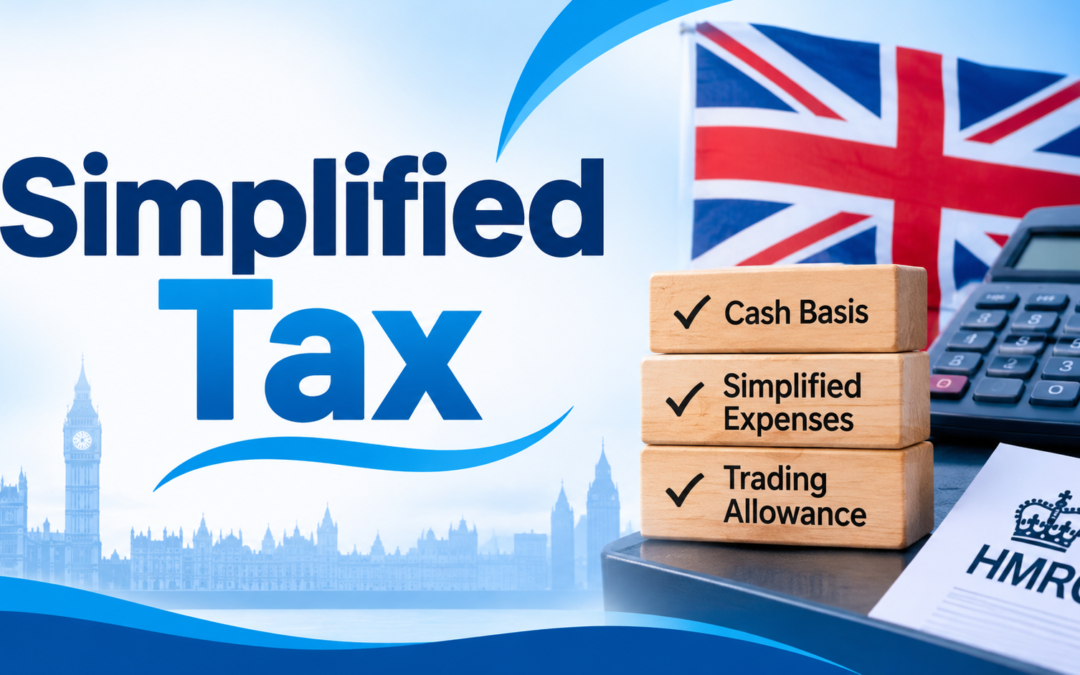
- Simplified tax UK rules offer three options: the cash basis, simplified expenses and the trading allowance.
- The cash basis has been the default for sole traders since 2024/25.
- Simplified expenses replace actual costs for vehicles, home working and living at your premises.
- The £1,000 trading allowance is used instead of expenses, never with them.
- Limited companies cannot use any of these options.
- Simple Assessment is a separate HMRC billing process, not an option you choose.
Simplified Tax UK: What It Means
When people search for simplified tax UK guidance, they usually mean the methods HMRC groups under “simpler income tax” (simpler income tax: simplified expenses). Each one tackles a different part of working out your taxable profit.
| Simplified tax option | What it does | Main benefit |
|---|---|---|
| Cash basis | Counts income and costs when money actually moves | No tracking of unpaid invoices or bills at the year end |
| Simplified expenses | Flat rates for vehicles, home working and living at your premises | Fewer receipts and no apportioning of bills |
| Trading allowance | A £1,000 tax-free allowance instead of claiming expenses | Very small side incomes can be tax-free with no records of costs |
You can use the cash basis and simplified expenses together. The trading allowance is different: if you use it, you cannot deduct any actual or flat-rate expenses from the same income.
Simplified tax is not Simple Assessment
The names sound alike, but Simple Assessment is a collection method, not a profit method.
HMRC can use it when it already holds the information it needs and cannot collect the tax in another way, for example through your tax code. Common cases include State Pension above the Personal Allowance, untaxed savings interest and some underpaid PAYE. HMRC works out the tax and sends a PA302 bill (Simple Assessment). You do not opt into it, and it plays no part in working out business profits.
Who Can Use Simplified Tax Options?
| Business type | Cash basis | Simplified expenses | Trading allowance |
|---|---|---|---|
| Sole trader | Yes (default), if eligible | Yes | Yes |
| Partnership whose partners are all individuals | Yes (default), if eligible | Yes | No: not against partnership profits |
| Partnership with a company partner, or an LLP | Restricted or not available | No | No |
| Limited company (company profits) | No | No | No |
| Landlord (property income) | Separate property rules | No | Use the property allowance instead |
A limited company always works out its profits under Corporation Tax rules, so none of these options can be used for company profits. A director is treated separately as an individual: if they also run a genuine sole trade of their own, that personal business can use the simplified tax UK options on the director’s own Self Assessment return. Mileage in the director’s own car for company work is paid by the company at the approved mileage rates instead.
Cash Basis Accounting UK: The Default Since 2024/25
Under the cash basis, the default simplified tax UK method, you record income when you are paid and expenses when you pay them. Under the alternative, the accruals basis, you record income when you earn it and costs when you incur them, even if no money has moved yet.
From 2024/25 the cash basis became the default for eligible unincorporated businesses: sole traders and partnerships whose partners are all individuals (expanding the cash basis). Limited companies cannot use it, LLPs and partnerships with a company partner are excluded or restricted, and certain specialised trades remain outside the rules, so eligibility is not automatic for every business. HMRC also removed several limits that used to put people off:
- The turnover limits (£150,000 to join, £300,000 to leave) no longer apply.
- The £500 cap on deducting interest has gone.
- From 2024/25 onwards, cash basis losses are no longer restricted. A qualifying loss may now be relieved against other income or carried back to earlier years, but the usual loss relief conditions, caps and time limits still apply.
Cash basis vs traditional (accruals) accounting
The cash basis is simpler, but it is not right for everyone. Accruals can give a fairer picture if you hold a lot of stock, if large invoices are often unpaid at the year end, or if a lender expects accruals accounts. You can opt out by election on your tax return, and you can later withdraw that election.
Moving between the cash basis and accruals
If you change basis, HMRC needs an adjustment so that no income or expense is counted twice or missed out. For example, an invoice raised under accruals but paid after you switch to the cash basis must not be taxed again. Your software or accountant works out this transitional adjustment, and it is worth taking advice the first time you switch.
Simplified Expenses for the Self-Employed: HMRC Flat Rates
Simplified expenses replace actual costs with HMRC flat rates in three areas only. Everything else, such as stock, phone bills or insurance not linked to a vehicle, is still claimed at actual cost (simplified expenses).
| Area | 2026/27 flat rate |
|---|---|
| Cars and goods vehicles | 55p a mile for the first 10,000 business miles, then 25p |
| Motorcycles | 24p a mile |
| Working from home (hours a month) | £10 for 25 to 50 hours, £18 for 51 to 100, £26 for 101 or more |
| Living at your business premises | Deduct £350, £500 or £650 a month for 1, 2 or 3+ people |
The 55p car rate rose from 45p on 6 April 2026 (increase to mileage rates). The premises rate is a deduction from your actual premises costs to remove private use, not an amount you claim (living at your business premises).
Maya works from home about 120 hours a month. The flat rate gives her £26 a month, or £312 a year, without working out a share of her bills. If her real extra costs are much higher, she can claim a fair share of actual costs instead.
That £312 reduces Maya’s taxable business profit; it is not a payment to her and not a £312 tax saving. Her actual benefit depends on her marginal tax rate and wider circumstances.
A couple run a B&B and live on the premises. Rather than splitting every bill, they deduct £500 a month, £6,000 a year, from their total premises costs for private use and claim the rest.
The £6,000 is the amount removed from total premises costs for private living. It is not an extra £6,000 expense on top of those costs.
What simplified expenses do not cover
The flat rates are the most visible part of simplified tax UK rules, but they replace only specific costs. The vehicle rate covers the costs of buying and running the vehicle, such as fuel, insurance, servicing, repairs and road tax, though parking and tolls on business journeys can still be claimed.
The home-working rate covers the household running costs linked to working at home, so you do not need to work out a business share of your utility bills. It does not include phone or internet costs, so the allowable business share of those can still be claimed at actual cost.
The vehicle lock-in rule
The mileage rate replaces all vehicle costs, including the cost of the vehicle itself. So if you use 55p and 25p for a car or van, you cannot also claim capital allowances on it or deduct its purchase price.
The rule works the other way too: once capital allowances, or a cash basis deduction for buying the vehicle, have been claimed, that vehicle cannot move to the flat rate. And once a vehicle is on the flat rate, it stays there for as long as you use it in the business (BIM75005). Decide before the first claim. Eternity Accountants explains the rates in more depth in its guide to simplified expenses.
Trading Allowance UK: £1,000 Tax-Free for 2026/27
The trading allowance gives individuals up to £1,000 a year of tax-free trading income (tax-free allowances on trading income). The £1,000 limit applies to your total gross income from all qualifying trades together, not to each one separately.
If that total is £1,000 or less in a tax year, you will usually not need to tell HMRC about it. You should still keep records, and you may have to complete a Self Assessment return for other reasons. Income from a partnership and some other exclusions can stop the allowance applying.
Above £1,000, you can still choose to deduct the allowance instead of your actual expenses. The key rule is that it is one or the other: you cannot deduct the £1,000 and claim expenses against the same income.
Ben earns £900 a year walking dogs at weekends and has no other trading income. The trading allowance covers it in full, so there is no tax on it. If he has no other reason to file a return, he will usually not need to report it, though he should keep a simple record of what he earned.
Rina sells crafts online. Her sales are £4,000 and her real costs are £600.
- Using the trading allowance: £4,000 − £1,000 = £3,000 taxable profit.
- Claiming actual costs: £4,000 − £600 = £3,400 taxable profit.
- Compared with claiming actual costs, the allowance cuts taxable trading profit by £400. At the 20% basic rate that is an illustrative Income Tax saving of £80, before any National Insurance or other effects are taken into account.
When the allowance is worse than claiming costs
If your real costs are more than £1,000, claiming them gives a lower profit, so the allowance does not help. It also cannot create a loss. A new business with heavy start-up costs is almost always better off claiming its actual expenses.
The Budget on 28 October 2026 announced that the trading allowance will go up from £1,000 to £3,000 from 6 April 2027. That change is meant to take effect for the 2027/28 tax year and still needs legislation. For 2026/27, the allowance remains £1,000.
Partnerships and the allowance
The trading allowance is a relief for individuals, but it cannot be set against trading income that comes from a partnership. Do not assume a separate sole trade automatically qualifies either: receiving payments from a partnership you are a member of can affect whether the allowance is available on your other trading or miscellaneous income. Check HMRC’s eligibility rules before claiming it.
Simplified Tax UK Options Compared: Which Should You Use?
Most sole traders using simplified tax UK rules end up with the cash basis plus one or two flat rates. The table shows a sensible starting point for common situations.
| Your situation | Best simplified tax option | Watch out for |
|---|---|---|
| Side income of £1,000 or less | Trading allowance | Other income may still mean you file a return |
| Small income with low costs | Trading allowance | Compare it with your actual costs each year |
| Trade with heavy van use | Compare 55p with actual costs | The vehicle lock-in rule |
| Working from home a few hours a week | Home working flat rate | Under 25 hours a month gets nothing |
| Living at your premises | Premises flat rate | Only covers premises costs |
| A loss-making year | Cash basis, claiming actual costs | The trading allowance cannot create a loss |
| Large stock or long credit terms | Consider accruals | Opting out needs an election |
Kieran is a self-employed electrician. He keeps the cash basis, so he only records jobs once he is paid. He uses the 55p flat rate for his van because his real running costs are lower than the rate would allow, and claims £18 a month for the 60 hours of quotes and admin he does at home. Stock and tools are still claimed at actual cost. He cannot use the trading allowance as well, because he is claiming expenses.
Our allowable expenses guide lists the costs you can still claim alongside any flat rates.
Records You Still Need to Keep
Simpler does not mean no records. Whichever simplified tax UK options you use, HMRC can ask how you reached your figures. Keep your records for at least 5 years after the 31 January filing deadline for the tax year. If you send a return very late, more than 4 years after the end of the tax year, keep the records for at least 15 months after the date you file it. The records should include:
- A record of all income received, with dates
- Receipts for any costs claimed at actual cost
- A mileage log if you use the vehicle flat rate
- A note of hours worked at home each month if you use the home working rate
- The number of people living at your premises each month, if you use the premises rate
Simplified Tax and Making Tax Digital
Simplified tax UK options and Making Tax Digital fit together. If you are in Making Tax Digital for Income Tax, you keep digital records and send quarterly updates through compatible software (Making Tax Digital for Income Tax). The simplified tax options still work: you can keep records on the cash basis, use flat rates and, where it applies, the trading allowance.
Check your software supports the option you choose before the tax year starts. Our free MTD check shows whether you are in scope.
The Push for a Simpler UK Tax System
“Simplified tax” is also used for the long-running effort to make the UK tax system easier. The Office of Tax Simplification advised the government on this for over a decade before it was abolished (Office of Tax Simplification). HMRC and the Treasury now lead that work themselves, through changes such as the expanded cash basis and the move to digital services. For small businesses, the practical result is the set of options described in this guide.
Mistakes to Avoid
| Mistake | What happens | How to avoid it |
|---|---|---|
| Using the trading allowance and expenses together | Profit understated, tax due later | Choose one or the other |
| Switching a vehicle between flat rate and actual costs | Not allowed while you keep the vehicle | Decide before the first claim |
| A limited company using flat rates | Not permitted | Use company rules and mileage payments |
| Assuming the cash basis suits every business | Distorted profits for stock-heavy trades | Review accruals if you hold stock |
| Confusing Simple Assessment with simplified tax | Wrong expectations about filing | Simple Assessment is HMRC’s bill, not a choice |
Simplified Tax UK: FAQs
What is simplified tax UK?
It usually means HMRC’s simpler income tax options for the self-employed: the cash basis, simplified expenses and the trading allowance.
Can a limited company use simplified tax options?
No. Limited companies, and partnerships with a company partner, must use the normal company or partnership rules.
Is the cash basis compulsory?
No. It is the default from 2024/25, but you can opt out and use the accruals basis by making an election.
Can I use the trading allowance and simplified expenses together?
No. If you use the trading allowance, you cannot deduct any expenses, flat-rate or actual, from the same income.
Do I still need receipts with simplified expenses?
Not for the costs the flat rate replaces, but you still need a mileage log, a record of home working hours and receipts for everything else.
What is the difference between simplified tax and Simple Assessment?
Simplified tax options help you work out business profits. Simple Assessment is HMRC calculating tax it cannot collect another way and sending you a bill, without a return.
Will the trading allowance go up?
Budget 2026 announced a rise from £1,000 to £3,000 from 6 April 2027, subject to legislation. For 2026/27 it stays at £1,000.
Do simplified tax options work with MTD?
Yes. You can use them in your Making Tax Digital records and quarterly updates through compatible software.
Final Verdict: Simplified Tax UK in 2026/27
Simplified tax UK options can cut your paperwork and, used well, your tax bill. Most sole traders should keep the cash basis, compare flat rates with real costs each year and treat the trading allowance as an either-or choice. Check the options before you file, and revisit them when your business changes.
- Check whether your business can use the simplified tax options.
- Compare the trading allowance and flat rates with your actual costs.
- Record your choices in your bookkeeping or MTD software before the year end.