Written and fact-checked by Oroni Chowdhury · Published: November 2026 · Last reviewed: November 2026 · Applies to the 2026/27 tax year
Running a pub looks simple from the customer’s side of the bar. From behind it, every pint carries VAT, duty, wages, energy, rent and business rates before a penny of profit appears. A plan that skips any of these can look healthy on paper and still run out of cash by February.
This guide shows how to put together a business plan for a pub that stands up to scrutiny. It covers what each section should say, a worked 12-month forecast with seasonality and VAT built in, the 2026/27 tax and payroll costs, licensing, and what pub companies and lenders actually check.
- Pub companies usually require a business plan before offering a tenancy or lease.
- Always forecast sales net of VAT: a £12,000 till week is £10,000 of real income.
- Separate drink (wet) and food (dry) sales, because their gross profit margins differ.
- From April 2026, smaller pubs in England pay business rates on lower retail, hospitality and leisure multipliers.
- Wages are usually the largest cost after stock; the National Living Wage is £12.71 an hour from April 2026.
- Plan for seasonality: a quiet January quarter can coincide with a large VAT bill.
What Is a Business Plan for a Pub and Who Asks for One?
A business plan for a pub is a written case for how the pub will attract customers, run smoothly and make enough money to cover its costs and pay you. It is also a test for yourself: if the numbers don’t work on paper, they won’t work behind the bar.
Pub companies, banks and lenders
- Pub companies (pubcos): most ask prospective tenants or leaseholders for a plan before offering an agreement, and many publish their own templates.
- Banks and lenders: want to see the forecast, your experience and how the loan will be repaid. GOV.UK’s guide to writing a business plan links to free templates.
- Investors or partners: look for a realistic view of risk and return.
How you will hold the pub
| Arrangement | What it means | Plan focus |
|---|---|---|
| Freehold | You own the building | Purchase funding, repairs, long-term value |
| Leasehold (free of tie) | You lease the property and buy drinks where you like | Rent, repairs liability, supplier prices |
| Tied tenancy or lease | You buy some or all drinks from the pubco | Tied prices, rent, pubco support |
| Management agreement | You run it for a share of takings | Your share, targets, costs you cover |
Tied tenants of pub companies owning 500 or more tied pubs in England and Wales have rights under the Pubs Code, including in some cases the option to request a market rent only agreement. The Pubs Code Adjudicator explains these rights.
What to Include: Section by Section
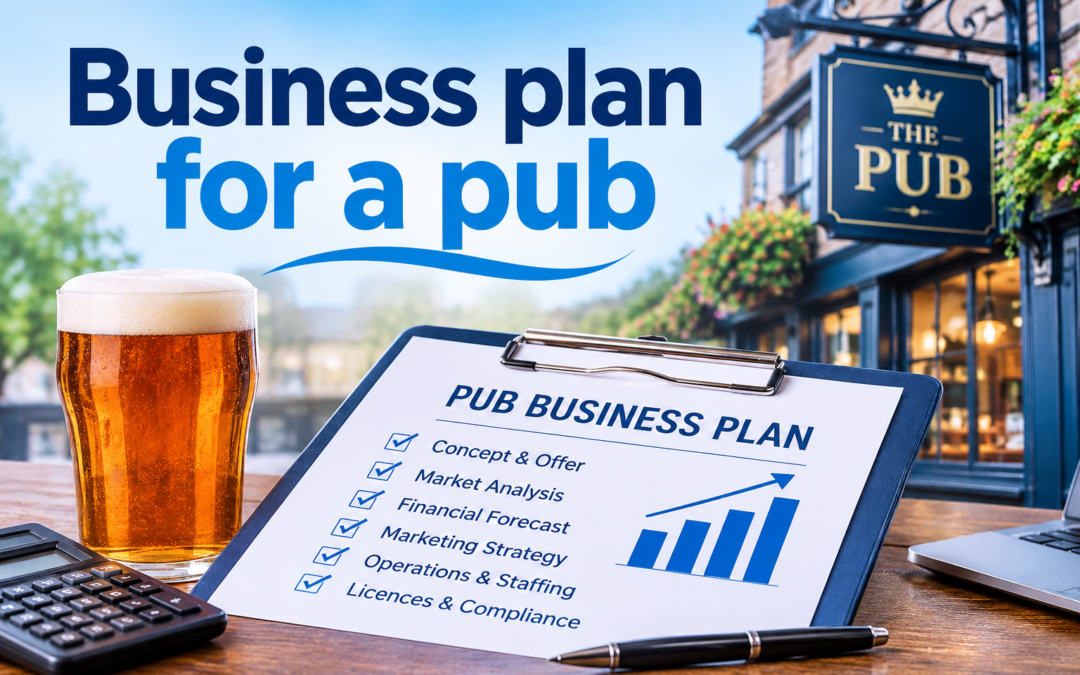
| Section | What to cover | What a pubco or lender checks |
|---|---|---|
| Executive summary | The pub, your offer and the headline numbers | A clear, credible story |
| Concept and offer | Wet-led or food-led, events, opening hours | Fit with the location |
| Local market | Population, footfall, competing pubs | Real evidence, not guesses |
| SWOT | Strengths, weaknesses, opportunities, threats | Honest threats |
| Marketing | Launch, social media, regular events | Low-cost, local tactics |
| Team and staffing | Your experience, staff numbers and rotas | Licensing and hospitality skills |
| Operations | Suppliers, cellar, food safety, systems | Control of stock and cash |
| Licensing and compliance | Premises licence, DPS, music licences | Nothing missing |
| Financial forecast | Sales, gross profit, costs, cash flow, break-even | Realistic, sourced assumptions |
| Risks | What could go wrong and your response | Contingency plans |
Keep the written sections short and specific. Most pubcos and lenders prefer a business plan for a pub that runs to a few pages of clear text plus the forecast, rather than a long document full of general statements about the industry.
The Numbers in a Business Plan for a Pub
The financial section is where most attempts at a business plan for a pub fall down. Build it from the bottom up, starting with what you expect to take through the till each week.
Sales: weekly takings, split by drink and food
- Estimate average weekly takings from the pub’s trading history, the pubco’s figures or similar local pubs.
- Split the total into wet (drink) and dry (food) sales, because each earns a different margin.
- Take VAT out: divide takings by 1.2 to find net sales.
- Adjust for seasonality, with stronger summer and Christmas trading and a quieter January to March.
Gross profit: wet and dry margins
Gross profit is net sales minus the cost of the drink and food sold. Drink margins depend heavily on supplier prices, which include alcohol duty. Duty rates rose by 3.66% on 1 February 2026, according to GOV.UK’s alcohol duty uprating notice. Tied tenants usually pay higher drink prices than free-of-tie operators, which lowers wet margins.
Running costs
List every overhead: wages and employer National Insurance, rent, energy, business rates, insurance, licences, music licensing, repairs, card fees, accountancy and marketing. Industry analysis reported in March 2026, based on British Beer and Pub Association cost data, suggested that a typical wet-led community pub kept only about 3p of profit from every £1 spent after rent. Small errors in costs therefore make a big difference.
Worked Forecast: Building a Business Plan for a Pub
The example below shows how the figures fit together in a business plan for a pub. Replace every assumption with your own pub’s data.
| Year 1 profit and loss | Amount |
|---|---|
| Net sales (£12,000 ÷ 1.2 × 52) | £520,000 |
| Gross profit (drink £226,200 + food £84,500) | £310,700 (59.8%) |
| Wages including employer NIC | £150,000 |
| Rent | £40,000 |
| Energy | £22,000 |
| Business rates (£30,000 × 38.2p) | £11,460 |
| Card fees (1.5% of till takings) | £9,360 |
| Accountancy, IT and other | £10,000 |
| Repairs | £8,000 |
| Marketing | £5,000 |
| Insurance | £4,000 |
| Licences and music | £2,500 |
| Total overheads | £262,320 |
| Profit before your own pay and tax | £48,380 (9.3%) |
Break-even takings
Excluding card fees, which rise with sales, fixed overheads are about £252,960. Each £1 of net sales contributes roughly 58p after stock and card fees. That means the Red Lion breaks even at about £436,500 of net sales a year: around £8,400 a week net, or £10,070 through the till including VAT.
Quarterly cash flow and VAT
| Quarter | Net sales | Gross profit | Overheads | Operating profit | VAT due for the quarter |
|---|---|---|---|---|---|
| Apr–Jun | £130,000 | £77,675 | £65,580 | £12,095 | £14,310 |
| Jul–Sep | £143,000 | £85,442 | £65,814 | £19,628 | £15,741 |
| Oct–Dec | £149,500 | £89,326 | £65,931 | £23,395 | £16,456 |
| Jan–Mar | £97,500 | £58,256 | £64,995 | –£6,739 | £10,732 |
Calculated in code from the assumptions above. VAT due is output VAT on sales less estimated input VAT on drink stock, energy, repairs and rent. Most food ingredients are zero-rated, so they carry little input VAT, even though the food you sell is standard-rated. The busy October to December quarter produces the largest VAT bill, which normally falls due in February, right in the loss-making quarter. A good plan shows exactly that squeeze and how you will cover it.
Tax, Rates and Payroll Costs to Build Into Your Plan
Tax and payroll costs are where a business plan for a pub most often understates the true cost of trading. Include each of the following in your forecast.
VAT
Almost every pub passes the £90,000 VAT registration threshold, so plan as a VAT-registered business from the start. Drinks and hot or eat-in food are standard-rated at 20%. Returns are usually quarterly, and our guide to paying HMRC VAT explains how payments work.
Business rates for 2026/27
In England, the 40% retail, hospitality and leisure relief ended on 31 March 2026. From 1 April 2026, occupied retail, hospitality and leisure properties with a rateable value under £500,000 are billed using lower multipliers: 38.2p for smaller properties and 43p for others, as councils such as Camden set out. Transitional relief limits sudden increases after the 2026 revaluation. Wales and Scotland have their own systems.
Wages and employer National Insurance
- The National Living Wage for workers aged 21 and over is £12.71 an hour from 1 April 2026.
- Employers pay National Insurance at 15% on earnings above £5,000 a year per employee.
- Eligible employers can claim the Employment Allowance of up to £10,500 a year against their NIC bill.
- Tips must be passed to staff in full and fairly, under the tipping law that took effect in October 2024.
Alcohol duty and draught relief
Pubs don’t usually pay alcohol duty directly; it is built into the price charged by brewers and wholesalers. Draught products in qualifying containers benefit from draught relief, a lower duty rate that helps on-trade pricing. Even so, each duty rise feeds into supplier prices and your wet margin.
Sole Trader, Partnership or Limited Company?
How you run the pub decides how its profit is taxed, so your business plan for a pub should state the structure and its tax effects.
- Sole trader or partnership: profit is taxed through Self Assessment at Income Tax rates plus Class 4 National Insurance. Our self-employed tax return guide explains the process.
- Limited company: the company pays Corporation Tax on its profit, and you are taxed on salary and dividends. Directors usually still file a return, as covered in our guide to Self Assessment for directors.
- Making Tax Digital: sole traders with qualifying income above £50,000 must keep digital records and send quarterly updates from April 2026. Qualifying income is gross takings, not profit, so most pub tenants will be in scope. Use our free MTD check.
Licences and Legal Checks
Licensing rules differ across the UK, so your plan should name the regime that applies.
- England and Wales: under the Licensing Act 2003 you need a premises licence for the pub and a designated premises supervisor (DPS) who holds a personal licence. Fees depend on rateable value bands; a council such as Oxford charges from £100 to £635 for an application, with higher fees for larger premises mainly selling alcohol.
- Scotland and Northern Ireland: separate licensing laws apply, so check with the local licensing board or council.
- Music: most pubs need a licence from PPL PRS to play recorded or live music.
- Food: register with the local council at least 28 days before you start serving food.
- Other: fire risk assessment, health and safety, employers’ liability insurance and right-to-work checks for staff.
What Pubcos and Lenders Look For
When a pubco or lender reads a business plan for a pub, these are the points they usually test first.
- Evidence-based sales estimates, ideally from the pub’s trading history
- Separate drink and food margins using real supplier prices
- A full list of costs, including rates, energy and employer NIC
- Monthly or quarterly cash flow with VAT timing
- Enough working capital to cover a quiet first winter
- Relevant experience and a clear staffing plan
- A personal budget showing what you need to live on
Several pub companies publish their own templates, such as Fuller’s business plan form. Use the pubco’s own format when you apply, with your forecast as the core.
Risks to Plan For
A credible business plan for a pub admits what could go wrong and shows how you would respond.
| Risk | Possible impact | Response in your plan |
|---|---|---|
| Energy price rises | Overheads up by thousands | Fixed-price contract, efficiency measures |
| Lower footfall | Sales below break-even | Events, food offer, downside forecast |
| Wage and NIC increases | Margins squeezed | Rota planning, price reviews |
| Duty or supplier price rises | Lower wet gross profit | Regular price reviews |
| Rent review | Higher fixed costs | Understand the terms before signing |
| Bad weather or local events | Uneven cash flow | Working capital buffer |
Business Plan for a Pub: FAQs
How much does it cost to open a pub?
It varies widely. Taking on a tenancy may need a deposit, stock, fit-out and working capital, while buying a freehold costs far more. Base your plan on the specific pub.
Do pub companies require a business plan?
Most do. Pubcos usually ask prospective tenants for a plan and forecast, and many supply their own template.
What gross profit should a pub make?
It depends on prices, tie terms and mix. Drink and food margins differ, so forecast each separately using real supplier prices.
How do I work out break-even?
Divide fixed overheads by the share of each £1 of net sales left after stock and variable costs.
Do I need to register for VAT?
Almost certainly. You must register once taxable turnover exceeds £90,000 in any rolling 12 months.
What business rates will a pub pay?
In England, pubs with a rateable value under £500,000 use the lower retail, hospitality and leisure multipliers from April 2026. Check the bill with your council.
Is a tied pub cheaper to run?
Rent may be lower, but tied drink prices are usually higher. Compare the total cost of both options in your forecast.
Can I write a business plan for a pub myself?
Yes. Many tenants do, using pubco templates. An accountant can check the forecast and tax figures.
Is there a free pub business plan template?
Yes. Several pub companies publish free templates, and GOV.UK links to general business plan templates.
Final Verdict: Writing a Business Plan for a Pub That Works in 2026/27
A strong business plan for a pub is built on net-of-VAT sales, separate drink and food margins and a complete list of costs, including the 2026/27 business rates, wages and employer NIC. Show your break-even takings and quarterly cash flow, and plan for the January squeeze. A plan built that way convinces a pubco or lender and protects you too.
- Collect the pub’s trading history and the pubco’s drink prices.
- Build a 12-month forecast net of VAT, with seasonality and break-even.
- Choose your business structure and plan for VAT, payroll and your first tax bill.
Tax Return Accountants doesn’t write business plans, but we can set up your bookkeeping, VAT and tax returns once the pub is trading.
- GOV.UK – Write a business plan
- GOV.UK – National Living Wage increases to £12.71
- GOV.UK – Alcohol duty uprating (1 February 2026)
- Camden Council – Business rates multipliers 2026 to 2027
- Pubs Code Adjudicator
- Oxford City Council – Premises licence fees
- The Drinks Business – Pub profit per £1 (March 2026)
- Fuller’s – Business plan template (2024)