

More than a traditional accountant, a CPA is a dependable advisor, financial strategist, and authority on compliance matters. In the UK, hiring or becoming a CPA opens doors to advanced financial services, from tax planning and auditing to business consultancy and strategic decision-making. Whether you are a small business owner looking to optimise finances, an individual seeking expert tax guidance, or a finance professional aiming for career growth, understanding the role of a certified public accountant is crucial.
CPAs are recognised for their expertise, credibility, and the rigorous standards they maintain. Unlike a regular accountant, a licensed UK accountant undergoes strict licensing and continuous professional development, ensuring clients receive reliable and authoritative advice. In this guide, we’ll explore everything you need to know about CPAs in the UK, including their responsibilities, benefits, how to become one, and why they are indispensable for both individuals and businesses.
In short: A CPA doesn’t just work with figures—they guide your finances, keep you compliant, help you save, and drive your business forward.
Who Is Considered a Certified Public Accountant (CPA)?
A CPA is an accredited accounting professional who helps individuals and businesses with financial planning, auditing, and advisory services. In the UK, CPAs are recognised for their high level of expertise, ethical standards, and ability to handle complex financial matters that go beyond regular accounting tasks.
In simple terms: Think of a CPA as a financial doctor—they check your financial health, fix issues, and give guidance for better money decisions.
CPA vs Regular Accountant – Key Differences
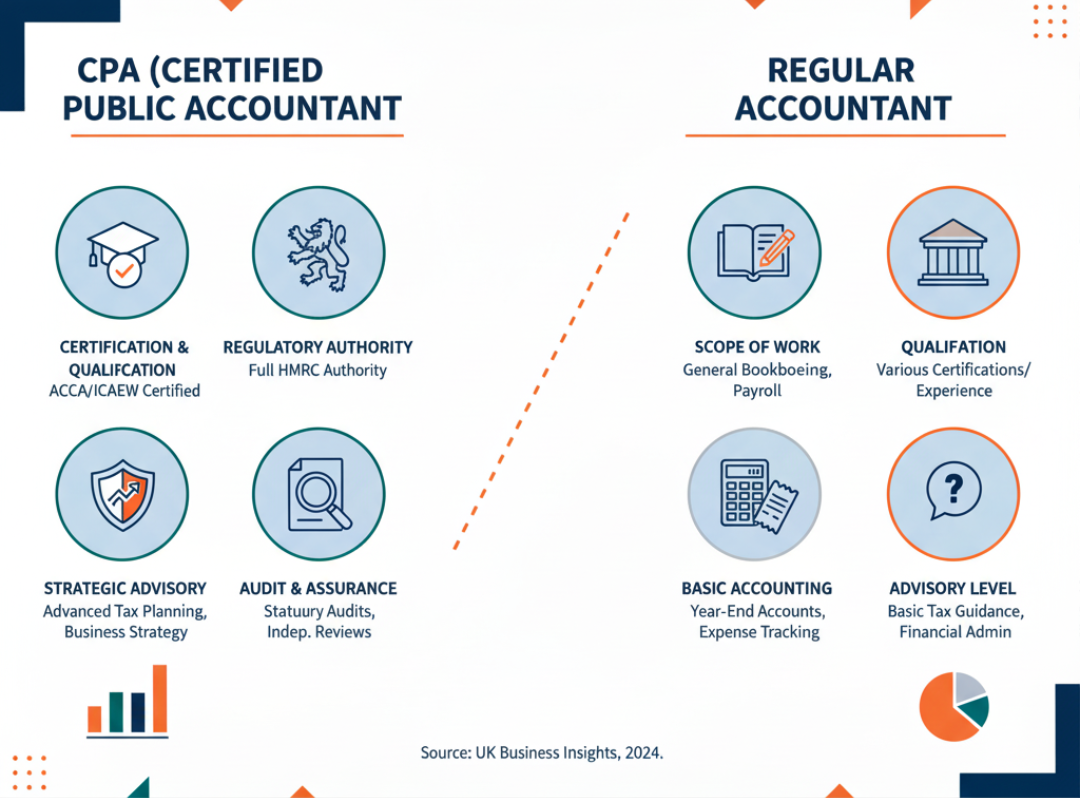
The main difference is certification, authority, and scope of services. CPAs are licensed professionals who can advise on taxes, audits, and strategy, while regular accountants focus on everyday bookkeeping.
In simple terms: If a regular accountant handles your monthly bills, a CPA helps you plan, save taxes, and represent you in front of HMRC.
Key Differences:
- Certification: A CPA has passed rigorous exams and meets professional licensing requirements.
- Expertise: CPAs handle tax planning, audits, and financial strategy, while regular accountants primarily focus on bookkeeping and basic financial statements.
- Authority: CPAs can represent clients in front of HMRC and provide official audit reports.
Example: For monthly bookkeeping, a small business owner may choose to work with a general accountant. But when filing complex tax returns or preparing for an HMRC audit, a professional auditor ensures compliance and optimises tax outcomes.
Q: How is a CPA different from a regular accountant?
A: CPAs have formal certification, can represent clients to HMRC, and handle complex financial matters.
In simple terms: A regular accountant manages records; a CPA strategises and protects your finances.
Roles and Responsibilities of a CPA
CPAs manage finances, ensure legal compliance, provide strategic advice, and represent clients professionally.
In simple terms: They don’t just record numbers—they protect your money, make sure everything is legal, and help you grow financially.
A CPA’s responsibilities often include:
- Preparing and reviewing financial statements
- Conducting audits and ensuring compliance with UK tax laws
- Advising on tax strategies and risk management
- Offering business consulting for financial growth
- Representing clients in financial or legal matters
Because of these roles, CPAs are crucial for individuals and companies looking for expert financial guidance.
What’s Unique About the CPA Credential in the UK?
Unlike other countries, the UK combines CPA recognition with other accounting certifications like ACCA or ICAEW. What sets CPAs apart in the UK:
- Adherence to both UK GAAP and IFRS standards
- Industry-regulated ethical and professional standards that CPAs must follow
- Ability to work across industries with legal and financial authority
A certified public accountant in the UK is a licensed financial expert who provides auditing, tax, and advisory services, ensuring both compliance and strategic financial growth.

Why Hire a Certified Public Accountant?
Hiring a certified accounting specialist can transform how you manage finances, offering both peace of mind and strategic advantages. CPAs provide expertise that goes beyond simple bookkeeping, helping individuals and businesses make informed decisions, minimise tax liabilities, and ensure compliance with UK financial regulations.
In simple terms: A CPA is like having a personal finance coach—they help you make smart decisions and avoid costly errors.
Benefits for Individuals
Individuals benefit from hiring a certified public accountant in multiple ways:
- Tax Optimisation: CPAs identify deductions and reliefs to reduce tax bills.
- Financial Planning: They help manage investments, pensions, and retirement strategies.
- Compliance Assurance: CPAs ensure your financial records meet HMRC requirements.
- Peace of Mind: A CPA provides professional management of even the most complex financial situations.
Example: A freelancer navigating multiple income streams can rely on a CPA to simplify tax returns and maximise savings legally.
Benefits for Businesses
For businesses, a licensed UK accountant is invaluable:
- Accurate Bookkeeping: Ensures reliable financial records.
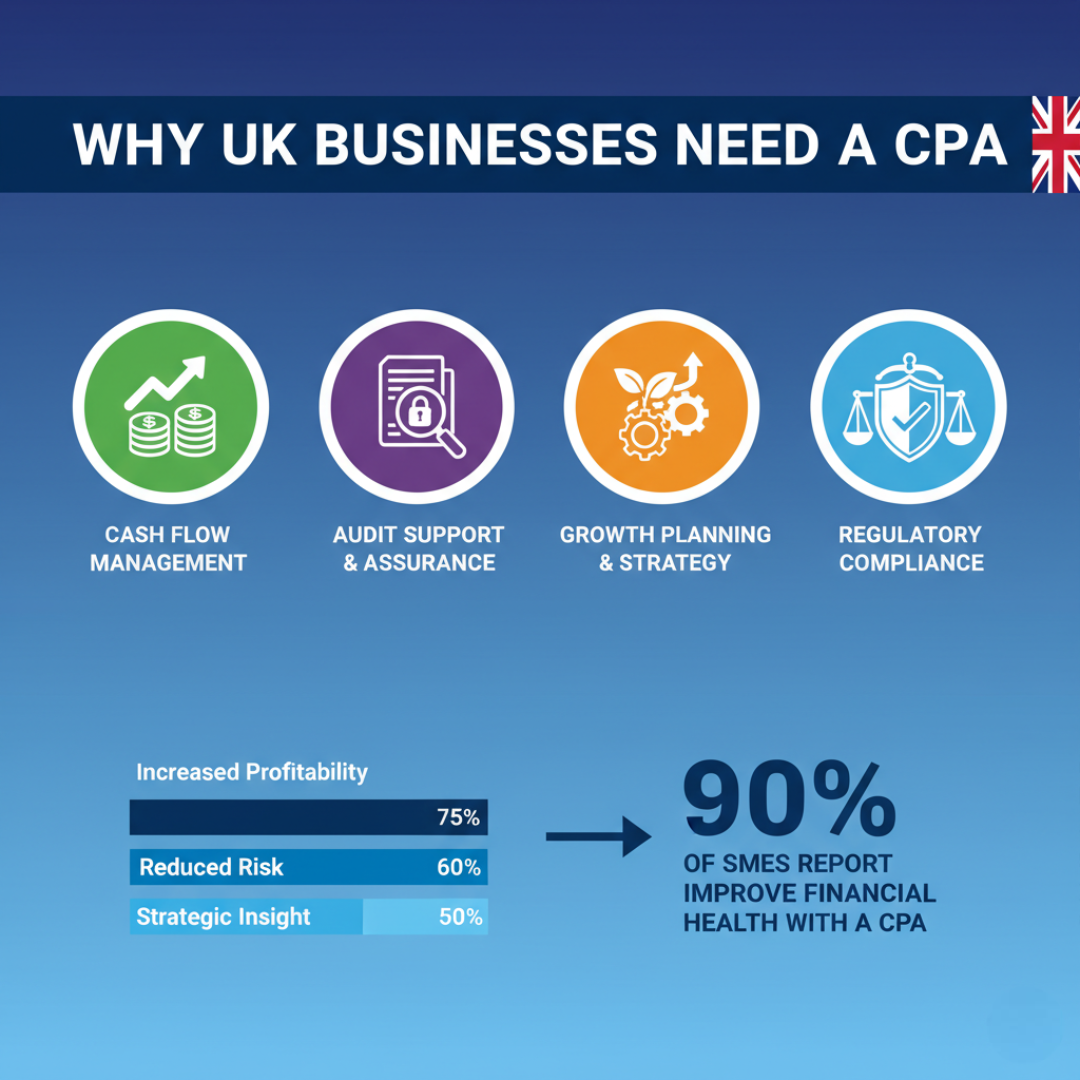
- Audit & Assurance Services: Guarantees compliance and credibility for stakeholders.
- Strategic Advisory: CPAs offer guidance on budgeting, forecasting, and expansion plans.
- Risk Management: They identify financial risks and compliance gaps early.
Example: A growing UK SME can rely on a CPA to streamline finances, prepare for HMRC audits, and plan for future growth.
Cost vs Value: Is Hiring a CPA Worth It?
While hiring a CPA involves fees, the value often outweighs the cost:
- Avoid costly tax mistakes and penalties.
- Optimise business and personal finances for maximum return.
- Gain expert insights that drive smarter decisions.
Hiring a certified public accountant ensures compliance, saves money, and provides professional guidance for both personal and business finances.
Guide to Becoming a CPA in the UK
Becoming a CPA in the UK requires formal education, practical experience, and passing strict exams—showing your expertise, credibility, and commitment to ethical finance.
Educational Requirements
To become a CPA, you typically need:
- An undergraduate degree in accounting, finance, or a similar discipline
- Coursework covering financial accounting, auditing, taxation, and business law.
- Some candidates pursue postgraduate certifications to strengthen their knowledge and career prospects.
Tip: UK universities often offer degrees aligned with CPA prerequisites, helping students meet exam eligibility requirements efficiently.
Professional Experience Needed
Hands-on experience is crucial:
- Most candidates must complete 2–3 years of supervised accounting work.
- Relevant experience covers auditing, tax services, financial reporting, and financial advice.
- Practical exposure ensures candidates can apply theory to real-world financial scenarios.
Example: Working in a corporate finance department or an accounting firm under a licensed CPA provides valuable experience for the licensing process.
CPA Exam & Licensing Process
The CPA designation is awarded after successfully completing:
- CPA Examination:
- Multiple sections covering auditing, financial accounting, taxation, and regulation.
- Tests both theoretical knowledge and practical application.
- Ethics Exam:
- Assesses understanding of professional standards and ethical responsibilities.
- Licensing Application:
- Submit proof of education, experience, and exam completion to a recognised UK licensing body.
- Maintain continuing professional development (CPD) credits annually.
Voice-Friendly Snippet:
Q: How many years are needed to become a CPA in the UK?
A: Typically, it takes 4–6 years, including a degree, professional experience, and passing all CPA exams.
Maintaining Your CPA Certification
Once certified, CPAs must:
- Maintain up-to-date knowledge through continuing education on UK taxes and accounting standards.
• Follow high ethical and professional conduct standards.
- Renew licenses periodically to maintain their professional standing.
Becoming a certified accounting specialist in the UK requires education, professional experience, passing exams, and ongoing learning to maintain certification.
Technology & the Future of Accounting for CPAs in the UK
Accounting is evolving, and UK CPAs are using technology to provide faster, smarter, and more accurate financial services—essential for businesses and individuals.
Automation and Cloud Accounting
- CPAs are increasingly using cloud-based accounting software to streamline bookkeeping, tax filing, and reporting.
- Reducing manual work through automation creates more time for strategic guidance.
- Example: UK SMEs can have real-time visibility into cash flow without spending hours reconciling accounts.
AI and Data Analytics
- Predictive analytics helps businesses forecast revenue, manage expenses, and mitigate financial risks.
- Using AI, CPAs can efficiently analyse data, detect trends, and deliver strategic guidance.
- Example: A CPA can detect unusual spending patterns instantly, helping prevent fraud or overspending.
Remote and Digital Services
- Many UK CPAs now offer fully remote services, making expert accounting accessible regardless of location.
- Digital communication and secure file sharing allow clients to collaborate efficiently with their CPA.
- Example: Freelancers in Manchester or startups in London can get the same high-quality CPA service without in-person visits.
The Future Outlook
- Technology will continue to reshape the CPA profession, combining financial expertise with tech skills.
- CPAs who leverage software, AI, and cloud solutions will provide faster, more accurate, and more strategic services.
- Staying ahead ensures UK businesses remain compliant, competitive, and financially agile.
Accounting in the UK is evolving into a fully digital profession. certified accounting specialist who embrace AI, cloud software, and remote services will deliver smarter insights, faster compliance, and strategic value for clients.
Q: How does technology affect CPAs in the UK?
A: CPAs now use cloud accounting, AI, and remote tools to work faster and more accurately.
In simple terms: Technology helps them save you time and give smarter advice.
CPA Services You Can Expect in the UK
A certified public accountant (CPA) provides much more than bookkeeping—they are your strategic financial partner. In the UK, CPAs ensure your finances are accurate, compliant with HMRC, and optimised for growth. Working with a CPA reduces errors, prevents costly penalties, and helps you make smarter decisions.
At Tax Return Accountants, our CPAs combine UK-specific expertise with tailored solutions to help individuals, freelancers, and businesses achieve financial confidence and success.
Tax Planning & Compliance
CPAs are experts in UK tax laws, ensuring your personal or business taxes are handled efficiently:
- Prepare and file accurate self-assessment or corporate tax returns
- Identify deductions, reliefs, and exemptions to maximise savings
- Represent you in dealings with HMRC, including audits and disputes
Example: A self-employed contractor in London relied on our CPA team to optimise expenses, submit timely self-assessment returns, and save thousands in taxes.
Audit and Assurance Services
Our CPAs act as your financial health inspectors, reviewing records and providing actionable insights:
- Carry out unbiased audits for businesses, big and small
- Assess internal controls and identify financial risks
- Provide assurance reports for stakeholders, investors, or lenders
Example: A small UK tech company relied on accountants to prepare an audit-compliant report, boosting investor confidence and enabling smooth funding rounds.
Business Advisory & Consulting
Beyond compliance, our CPAs help your business grow strategically:
- Develop budgets, forecasts, and financial plans
- Advise on mergers, acquisitions, and expansion opportunities
- Analyse profitability and efficiency improvements
Example: A UK SME planning to expand internationally consulted our CPAs to evaluate taxation, cash flow, and regulatory compliance across multiple jurisdictions.
Financial Performance Analysis
Our team prepares in-depth financial reports to help you make smarter decisions:
- Monthly, quarterly, or annual financial statements
- Performance analysis and trend identification
- Insights for investments, funding, and growth strategies
Partnering with Tax Return Accountants means access to full-service tax, audit, advisory, and financial reporting solutions. Our CPA team ensures HMRC compliance and helps businesses grow—book your free consultation now.
UK Legal & Regulatory Framework for Certified Public Accountants
A certified accounting specialist in the UK must comply with specific legal and regulatory standards to ensure accurate financial reporting and full compliance with tax laws. Understanding these frameworks is critical for both CPAs and their clients.
HMRC Compliance
- CPAs must adhere to HM Revenue & Customs (HMRC) rules for tax filing, VAT, payroll, and self-assessment submissions.
- Representation before HMRC is a key advantage of hiring a CPA — they can handle audits, disputes, and tax investigations efficiently.
- Example: Filing complex VAT returns or managing PAYE schemes for small UK businesses requires expert CPA guidance to avoid fines.
UK GAAP (Generally Accepted Accounting Practice)
- CPAs follow UK GAAP, the standard framework for financial reporting in the UK.
- Ensuring financial statements are reliable, consistent, and transparent for all stakeholders.
- Example: Preparing year-end accounts for a limited company in compliance with UK GAAP avoids legal complications and supports business credibility.
IFRS in the UK
- For companies with international operations or listed entities, CPAs must also comply with International Financial Reporting Standards (IFRS).
- Understanding both UK GAAP and IFRS allows CPAs to deliver accurate reporting for multinational clients or global investors.
- Example: A London-based tech startup seeking foreign investment benefits from CPA-prepared IFRS-compliant financial statements.
Ethical and Professional Standards
- CPAs in the UK are bound by codes of ethics from recognised bodies (ICAEW, ACCA).
- Ethical practice includes independence in audits, confidentiality, and integrity in financial advice.
A certified public accountant in the UK ensures compliance with HMRC, prepares accounts under UK GAAP, and aligns reporting with IFRS for international standards, all while adhering to strict ethical and professional guidelines.
Q: How many years does it take to qualify as a CPA in the UK?
A: It typically takes 4–6 years, including a degree, professional experience, and exams.
In simple terms: Becoming a CPA is a serious commitment, but it shows expertise and credibility.
Finding the CPA That Fits Your Business or Financial Goals
The right certified public accountant can play a key role in achieving financial success. The right CPA doesn’t just handle numbers—they become a trusted advisor who helps you save money, grow your business, and stay compliant with UK financial regulations.
Verify Certification and Credentials
Always ensure your CPA is fully licensed and in good standing with recognised UK regulatory bodies. Check:
- Professional certifications (CPA, ACCA, ICAEW).
- Licensing status and ethical record.
- Membership with professional associations for credibility.
Pro Tip: A verified CPA signals expertise, trustworthiness, and adherence to high ethical standards.
Look for Experience in Your Industry
Different industries have unique financial challenges. With relevant experience, a CPA can provide personalised guidance:
SMEs benefit from CPAs familiar with small business taxation.
- Freelancers and contractors need CPAs who understand self-assessment rules.
- Larger corporations require CPAs skilled in audits and corporate finance.
Example: A retail business in London should hire a CPA who understands VAT, payroll, and inventory accounting.
Transparent Pricing and Service Packages
Choose a CPA who offers clear pricing structures and explains the scope of services upfront:
- Hourly rates vs fixed fees
- Service packages for bookkeeping, tax, and advisory
- Hidden costs and additional charges
Tip: Transparency avoids surprises and builds trust for a long-term relationship.
Check Client Testimonials and References
Reputable CPAs should have positive reviews, case studies, or client referrals:
- Ask for success stories or examples of saved taxes and streamlined finances.
- Look for testimonials highlighting professionalism, responsiveness, and results.
- Verify online reviews or LinkedIn recommendations.
Build a Partnership, Not Just a Service
The best CPA becomes a strategic partner, not just a number-cruncher:
- Regularly review your finances together.
- Provide proactive advice, not just reactive solutions.
- Assist with growth planning, risk management, and tax optimisation.
Q: Is this CPA suitable for my business needs?
A: Check their certification, experience in your industry, transparent pricing, and client feedback to ensure they align with your financial goals.
Case Study: How a UK Micro-Business Benefited from CPA Services
Client: A small artisan bakery in Bath, England
Challenge: The bakery was struggling to manage VAT filings, payroll for three employees, and quarterly tax submissions. Mistakes in bookkeeping had led to fines and missed deductions, and the owner was spending 10+ hours a week on accounts instead of focusing on growing the business.
Solution: The bakery hired a Professional Accountant (CPA). The CPA:
- Reviewed and reorganised the bookkeeping system.
- Optimised VAT and tax filings to maximise eligible deductions.
- Set up automated payroll and financial reporting.
- Provided strategic advice for budgeting and inventory management.
Results:
- Saved £5,200 in taxes within the first year.
- Reduced bookkeeping time from 10+ hours per week to 2 hours per week.
- Enabled the owner to focus on marketing, product development, and expanding to a second location.
Even a small micro-business can achieve significant savings, efficiency, and growth by working with a certified public accountant.
Key Questions About Certified Public Accountants
Q: What are the typical CPA fees in the UK?
A: CPA fees vary depending on services and complexity. For individuals, rates may start around £50–£150 per hour, while businesses may pay £200–£500+ per hour for advisory or auditing services. Many CPAs also offer fixed-fee packages for standard accounting tasks.
Q: Can a CPA represent me in HMRC matters?
A: Yes. A certified public accountant can represent clients in audits, tax disputes, and correspondence with HMRC, providing professional guidance and ensuring compliance.
Q: Do all accountants need CPA certification?
A: No. Regular accountants can provide basic bookkeeping and tax services, but a CPA holds additional licensing and expertise, enabling them to perform audits, advisory work, and complex financial planning.
Q: How long is the process to become a CPA in the UK?
A: It typically takes 4–6 years, including completing a degree, gaining professional experience, and passing CPA examinations. Maintaining certification requires continuous professional learning.
Q: CPA vs Chartered Accountant – What’s the difference?
A: Both are highly qualified financial professionals. The main difference is licensing and international recognition. CPAs often have global recognition and a focus on auditing and advisory services, while Chartered Accountants (CA) are highly specialised in UK accounting standards and regulations.
Q: What services does a CPA offer for small businesses?
A: Small businesses benefit from CPAs through:
- Accurate bookkeeping and tax filing
- Budgeting and forecasting
- Audit preparation
- Strategic business advice
A certified public accountant provides expert advice on taxation, audits, financial reporting, and business strategy. Their services are trusted for accuracy, compliance, and strategic insights.
Conclusion
A certified public accountant (CPA) is an essential partner for anyone seeking financial clarity, compliance, and growth in the UK. From tax planning and audits to strategic business advice, a CPA ensures that your finances are handled professionally, efficiently, and in full alignment with UK laws. No matter your role—individual, freelancer, or business owner—the right CPA can protect your finances, cut costs, and provide actionable insights.
When choosing a CPA, it’s important to select a professional who is licensed, experienced in your industry, transparent in pricing, and highly trusted by clients.
Ready to take control of your finances?
Don’t wait—optimise your taxes and protect your finances before your next HMRC deadline. Contact Tax Return Accountants today to get a free consultation and discover how our certified public accountants can help you save money, stay compliant, and achieve financial confidence.